Bear Spray for Hikers: Legal States, Fit, and When It Helps

Maya Lin
Maya Lin is a travel journalist and outdoor enthusiast who believes the best trips combine rugged adventures with urban comforts. After spending six years backpacking across four continents, she founded Trail & Town Guide to help fellow travelers navigate both hidden mountain passes and bustling city neighborhoods with confidence.
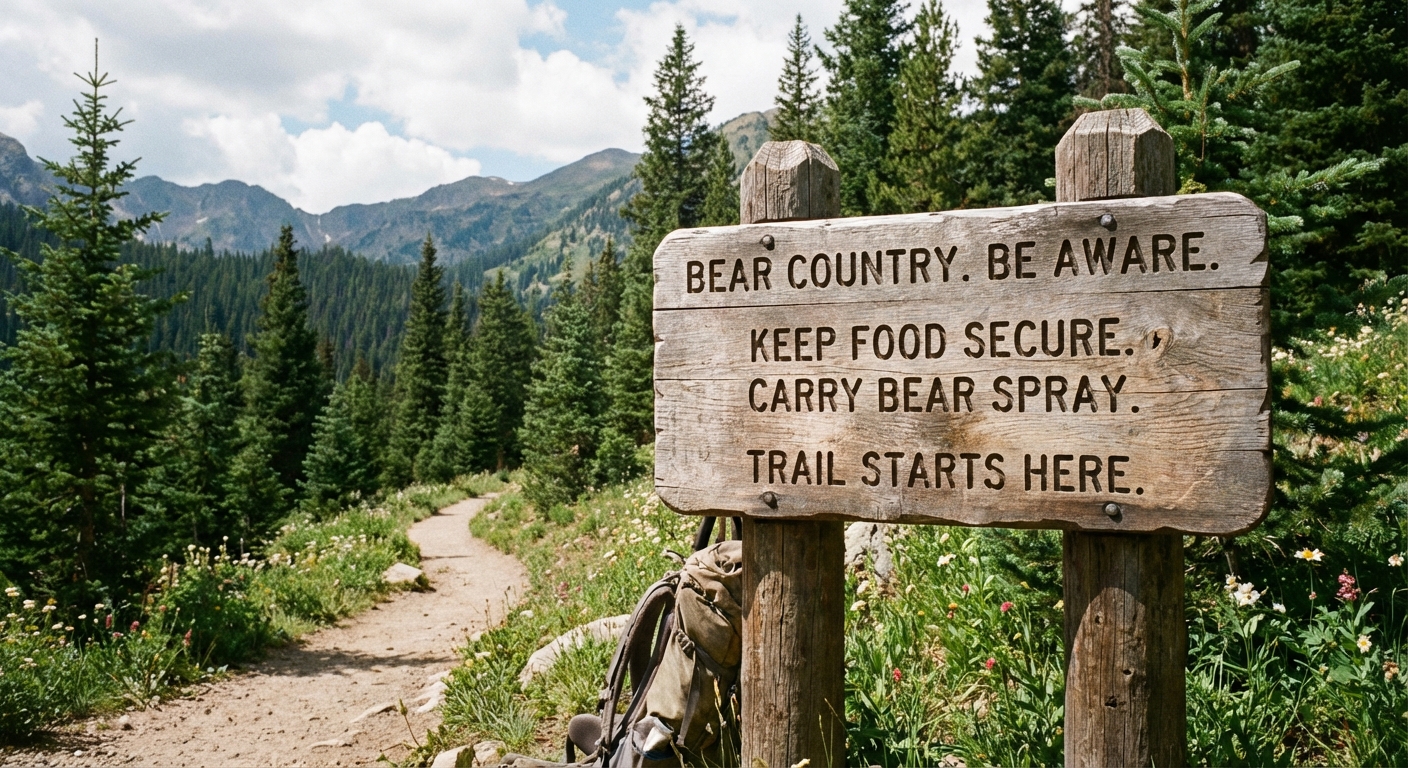
Bear spray is one of those pieces of gear that feels like overkill right up until it does not. I think of it like a seatbelt for bear country: you hope you never need it, but you want it fast, you want it working, and you want to know you are allowed to carry it where you are hiking.
This is an equipment-focused guide. If you are looking for encounter behavior like what to do when you see a bear, how to talk calmly, when to back away, and what to do in a bluff charge, that is a separate skills conversation. Here, we are focusing on the canister in your hand: what it is, where it is legal, how to carry it, how to practice without blasting your hiking partner, and when bear spray realistically helps.
Bear spray vs. bug repellent
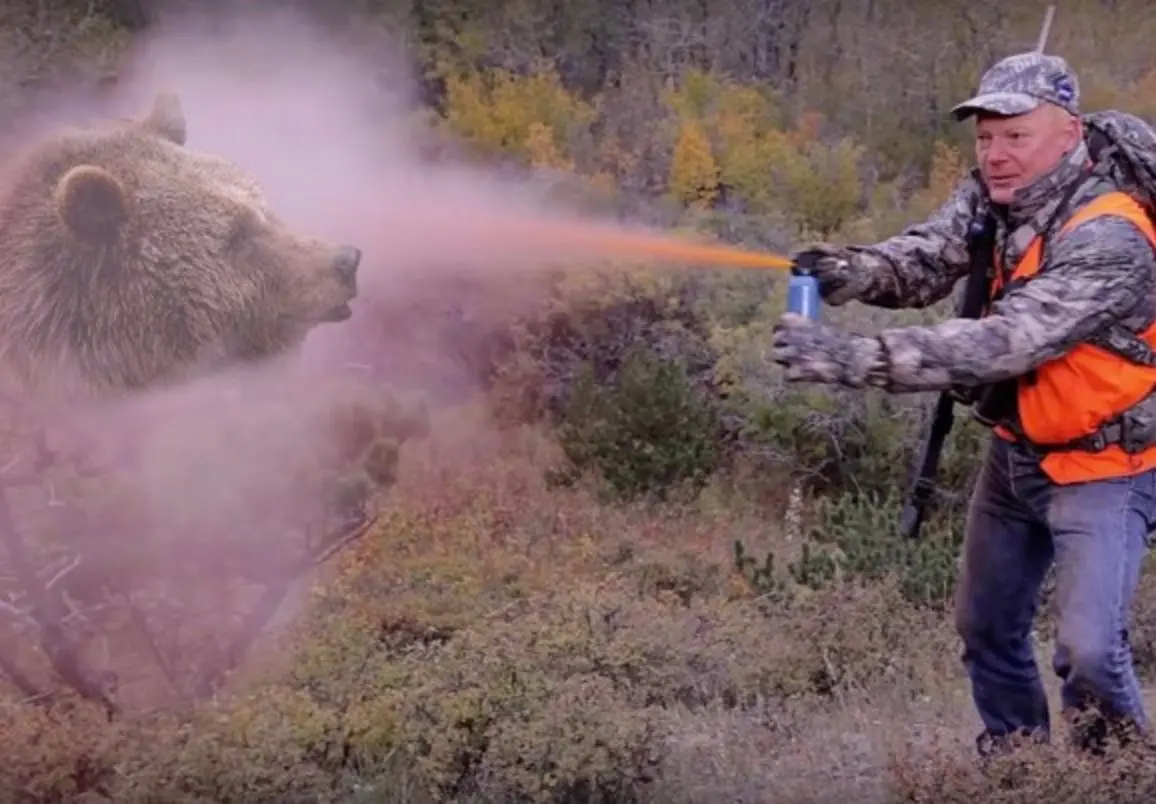
The most common bear spray mistake happens before you even leave the store: mixing up bear deterrent with pepper spray for humans or assuming any “repellent” will do the job.
What bear spray is
Bear spray is a large canister of capsaicin-based irritant formulated and packaged specifically for stopping a charging bear at close range. In the US it is typically registered with the EPA as a bear deterrent. In Canada it is regulated through the PMRA. Labels and formats vary by brand, but the key is that it is registered and labeled for bear deterrence with specific directions.
- It is not a “bear repellent” you apply to your body or gear.
- It is not bug spray.
- It is not a mini keychain pepper spray meant for self-defense against people, which usually has a narrower stream and smaller volume.
What to look for on the label
Different brands vary, but good hiking-ready bear spray generally has:
- Clear “bear deterrent” labeling and registration info (EPA in the US, PMRA in Canada).
- CRC concentration commonly in the 1.0% to 2.0% range (Capsaicin and Related Capsaicinoids).
- Can size that meets common minimums for bear spray, typically 7.9 oz / 225 g or larger.
- High volume and longer range compared to personal pepper spray.
- A safety clip that is secure but easy to release with one hand.
- An expiration date you can read without squinting.
If the can says “pepper spray” but does not clearly state it is for bears, assume it is not the right tool for bear country.
Where it is legal in the US
In the US, bear spray is broadly legal to possess and use for self-defense against animals in the places hikers typically need it, including many national parks in bear habitat. The confusion tends to come from a few specific situations: air travel, certain state restrictions on pepper spray sales, and local rules about discharging irritants. Also note that specific facilities or services can have their own policies (think visitor centers, shuttles, and concession-run buildings).
The simple rule
In most US states, it is legal to carry bear spray for backcountry travel. If you are traveling to a big-name bear destination like Yellowstone, Glacier, Grand Teton, the Tetons, the Bob Marshall, the North Cascades, or Alaska, bear spray is a standard piece of safety gear. Still, treat “Alaska” as a travel shorthand, not a single uniform rule set. Always check the land unit you are visiting.
States and places to double-check
Some states have special rules around pepper spray products, including limits on size, concentration, who can purchase, or where it can be shipped. Those rules are often aimed at personal defense sprays, but they can still affect bear spray availability at retailers or shipping to your address.
- New York and Massachusetts are the classic examples where pepper spray sales are more restricted than most states. If you are flying into one of these states and driving onward, do not assume you can easily buy a big canister at any random store.
- College campuses, government buildings, and some venues may have blanket “no irritant spray” policies that apply regardless of whether it is for bears.
Best practice: check the rules for (1) your departure airport, (2) your arrival state, and (3) the specific park or land unit you are hiking in. If you are unsure, call the park visitor center or ranger district and ask about bear spray carriage and storage.
National parks
Many national parks strongly recommend bear spray in grizzly country. Some parks also have guidance about:
- Where to buy it near entrances.
- What not to do with it (like testing it in a campground).
- How to store it around people and food prep areas.
Even when it is allowed, discharging bear spray is not casual. Spraying it as a joke, at a trailhead, or inside a building can trigger law enforcement response and potentially citations. Treat it like a safety device, not a toy.
Flying with bear spray
If you are planning a fly-in hiking trip, this is the part that saves you a miserable surprise at airport security.
Usually not allowed
In the US, TSA rules for “self-defense sprays” can be nuanced, but bear spray is commonly treated as a hazardous irritant. It is not allowed in carry-on bags, and most airlines prohibit it in checked luggage as well. Policies can change, and enforcement can vary, so do not gamble.
Best move: confirm current guidance with TSA and your airline, then plan as if you will not be able to fly with it.
What to do instead:
- Buy it at your destination (outdoor stores, some grocery stores, visitor centers near major parks).
- Rent it in popular grizzly destinations, especially near airports and gateway towns.
- Ship it ahead via ground service where permitted, to a hotel or outfitter that will hold it.
International travel
Crossing borders with bear spray can introduce additional restrictions and declarations. If you are traveling between the US and Canada for hiking, research import rules ahead of time and consider purchasing in-country to avoid delays.
How to carry it
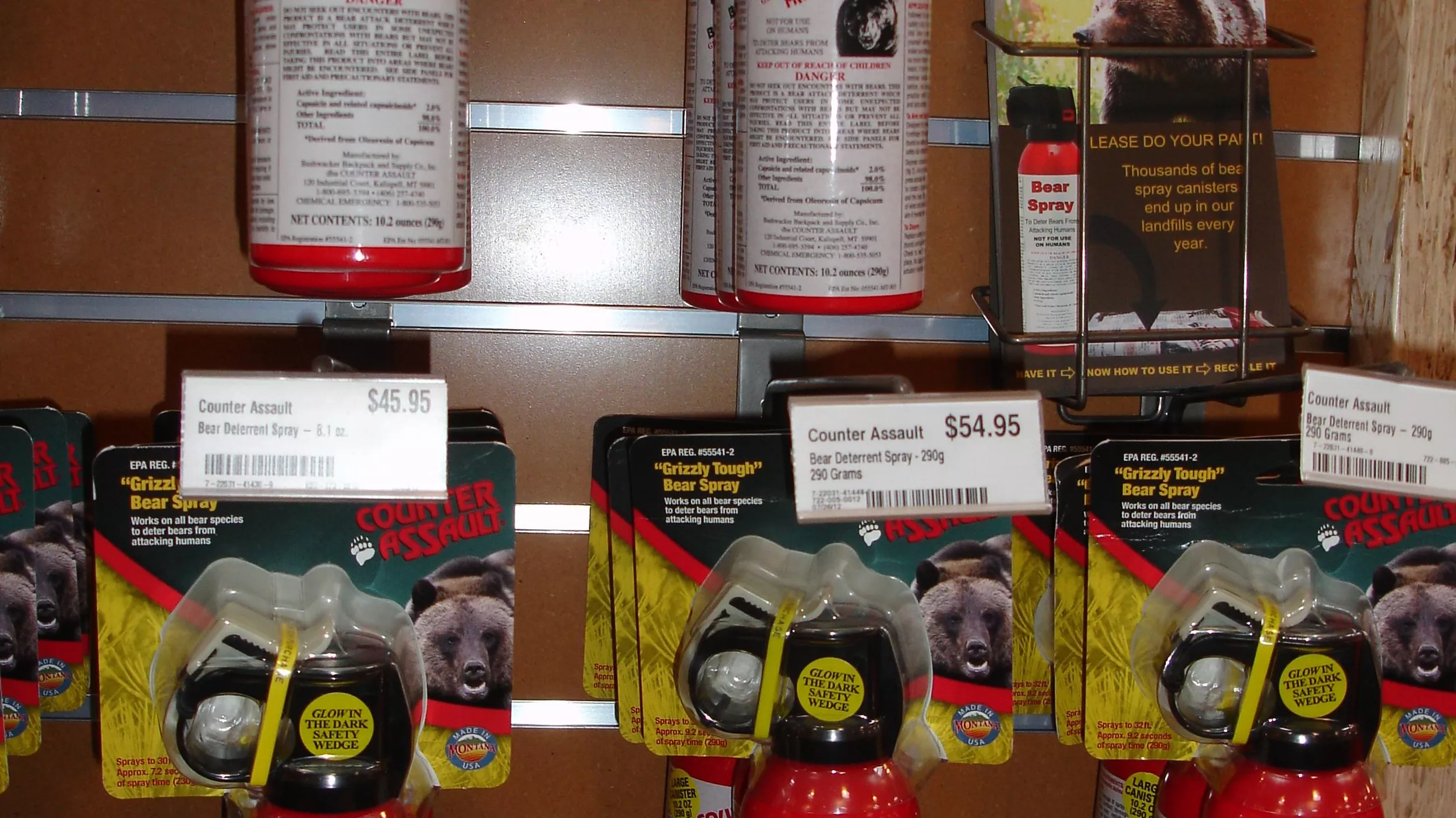
Bear spray only helps if you can deploy it quickly with one hand while your brain is doing backflips. That means your carrying method matters as much as the brand.
On your body, not in your pack
In a real encounter, you may not have time to unzip anything. Carry bear spray:
- On a belt holster
- On your pack hip belt
- In a chest harness holster (my favorite for consistent access with different packs)
Avoid: side water bottle pockets, top lid, brain pocket, or buried “easy access” pockets. Those work for snacks, not for a two-second decision.
Right side or left side?
Put it on the side of your dominant hand, angled so you can:
- Grab the canister without twisting your wrist
- Pull it straight out of the holster
- Pop the safety clip with your thumb
Then practice the motion slowly a few times at home with the canister safety engaged (finger off trigger).
Holster placement tips
- Do not block it with a jacket hem. If your rain shell covers the holster, it is not accessible.
- Mind your pack straps. Some hip belt pockets or tightening straps can snag the can.
- Check it on breaks. Sit-down snack breaks are where holsters get bumped loose.
Practice safely
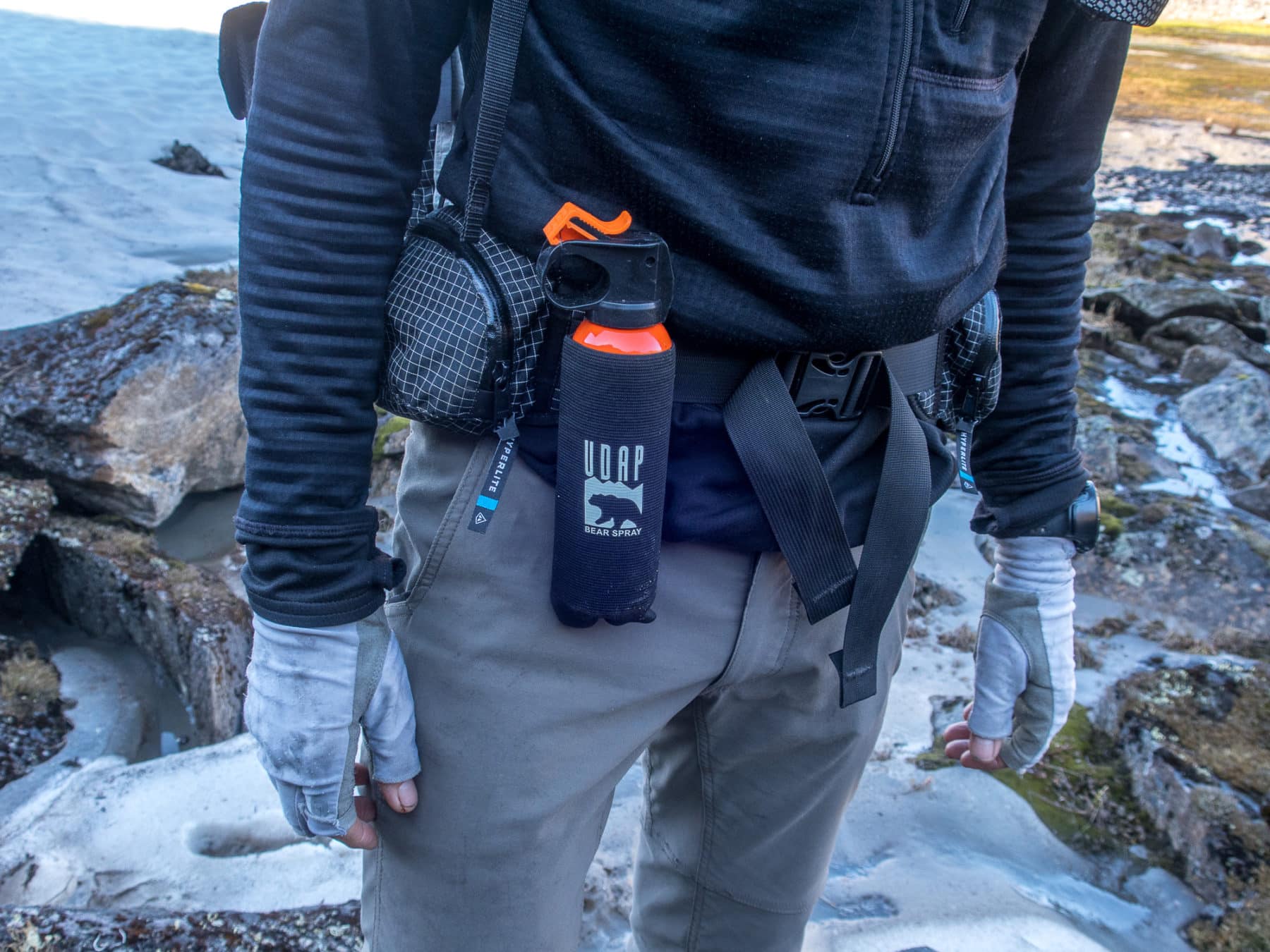
The goal of practice is not to empty your can. The goal is to build a clean, repeatable sequence: grab, release safety, aim, short burst, adjust.
Use an inert trainer
Many brands sell an inert trainer that mimics the canister size and trigger feel without the capsaicin. If you hike in grizzly country often, it is worth it.
If you only have a real canister
Do not “test fire” it at a trailhead or campsite. Bear spray lingers, can contaminate clothing and gear, and can cause serious respiratory and eye irritation to people and pets.
Instead:
- Practice the draw and safety removal at home with the canister pointed in a safe direction.
- Read the label until you can visualize the steps without looking.
- Know the range and spray duration printed on the can.
A quick in-the-moment protocol
- Get it out early, not at the last second. If a bear is approaching and not giving you space, draw the can and get ready. Keep the safety on until you truly need it.
- Mind the wind. If possible, angle so the cloud moves toward the bear, not back into your face.
- Aim low. You are building a wall the bear runs into, not trying to tag its face like a squirt gun.
- Short bursts, sweep. Spray 1 to 2 second bursts and sweep side-to-side to keep a cloud between you and the bear.
- Stop when it disengages. If the bear breaks off, stop spraying. Keep the can ready and create distance.
Gear note from too many windy ridge hikes: if you are in a crosswind, you may need to aim slightly upwind to build a cloud in the bear’s path. Practice with an inert trainer makes this feel less like guesswork.
When it helps
Bear spray is not a force field. It is most effective in a narrow set of circumstances, and those circumstances are exactly the ones hikers worry about most: close-range, fast-moving encounters where a bear continues approaching.
Scenario 1: Blind corner
You round a bend and a bear is suddenly within a short distance. The bear is startled, you are startled, and the next few seconds are messy.
If the bear continues toward you or charges, bear spray can be a decisive tool. Your advantage is speed: if it is on your belt, you can get it up quickly while backing away.
Scenario 2: A charge that does not stop
Many charges are defensive and may stop on their own, especially with grizzlies protecting food or cubs. Bear spray is your last-ditch tool when the bear is still closing distance.
In that moment, creating a cloud the bear runs through often breaks the charge.
Scenario 3: Bear present, not interested
A bear grazing in a meadow or moving across a slope is not automatically a bear-spray moment.
Spraying from far away is usually ineffective, wastes your can, and can create extra risk and confusion for the animal, other hikers, and you. This is where giving space and leaving the area are more appropriate.
Scenario 4: Predatory behavior
Predatory behavior is uncommon, but it is the scenario most people picture in nightmares. If a bear follows you, closes distance deliberately, or does not respond to your efforts to leave, bear spray is one of the few tools that can create an immediate barrier.
If you are in this territory, prioritize getting out and reporting the incident as soon as you are safe.
Grizzly vs. black bear
This is where I land after years of hiking around both kinds of bear habitat: if you can carry bear spray comfortably, it is a low-friction safety upgrade in most places where bears are present. But the urgency changes with species, location, and trail context.
In grizzly country
Carry it. Full stop. Grizzlies tend to be more defensive, and surprise encounters in thick brush, along noisy creeks, or on tight switchbacks are the classic setup where bear spray is most relevant.
In black bear country
Black bears are often more likely to avoid people, but that does not mean incidents never happen. Food-conditioned bears around busy trailheads and campgrounds are a different vibe than a shy bear deep in the woods.
Consider carrying it if:
- You are hiking solo or at dawn and dusk
- You are in berry season or heavy forage areas
- The area has frequent bear activity reports
- You are on narrow, brushy trails with limited sight lines
If the only thing stopping you is comfort or access, a chest holster is usually the fix.
Choosing a canister
You do not need the fanciest option, but you do need a canister you can use confidently.
Size and duration
Most hiking-oriented canisters fall into a sweet spot that balances carry weight and spray time. As a reality check, standard canisters empty extremely fast, usually in the neighborhood of 7 to 9 seconds total. That is why “short bursts” is not just technique advice. It is can-management.
Group tip: one canister per person is ideal in grizzly country, because the person closest to the bear needs immediate access. Sharing one can across a group often means the can is on the wrong hip at the wrong moment.
Range
Do not obsess over maximum distance claims. What matters is effective range in real conditions: wind, adrenaline, uneven footing, and a moving target. Still, it helps to have a baseline: many hiking cans advertise something like 20 to 35 feet of range, depending on brand and conditions.
Expiration and storage
- Do not carry expired bear spray. Pressure and performance can degrade over time.
- Avoid high heat. Do not leave it baking in a car dashboard in summer.
- Respect extreme cold. Freezing temperatures can temporarily reduce canister pressure and effective spray distance. Keep it accessible, but consider keeping it insulated under a layer when conditions are truly frigid.
- Do not puncture or “dispose” creatively. Follow local hazardous waste guidance for disposal.
Common mistakes
- It is in the pack. The bear will not pause while you unzip.
- The safety clip is unfamiliar. You should be able to release it by feel.
- The holster is loose. Canister bounces out on scrambles or while glissading.
- Spraying too early. Wastes the can, and now you are out of your best tool if things escalate.
- Spraying into the wind. A face full of capsaicin is a terrible time to be making decisions.
- Assuming bear spray replaces good habits. Noise in dense brush, food storage, and awareness still do most of the work.
After you spray
If you ever deploy bear spray in a real encounter, think in terms of getting out cleanly, not “winning.”
- Leave the area. Create distance without running.
- Keep the can ready. A second burst may be needed if the bear re-approaches.
- Expect lingering aerosol. Avoid rubbing your eyes, and be careful with contaminated gloves, sleeves, and pack straps.
- Report it. If the bear was aggressive, persistent, or the incident happened near a trailhead or campground, report it to rangers or local land managers when you are safe.
Pre-hike checklist
If you want the simple routine I use before a bear-country day hike, it is this:
- Check the can: expiration date, no dents or leaks, safety clip seated.
- Check placement: on-body, accessible with dominant hand, not covered by a jacket.
- Talk with your group: who has spray, where it is carried, and what “spray” means if someone shouts it.
- Know the local context: recent bear activity reports, seasonal closures, food storage rules.
Bear spray is not about fear. It is about being prepared enough to hike with your head up, enjoy the trail, and still stop for that perfect coffee in town afterward.