Hiking in Wildfire Smoke
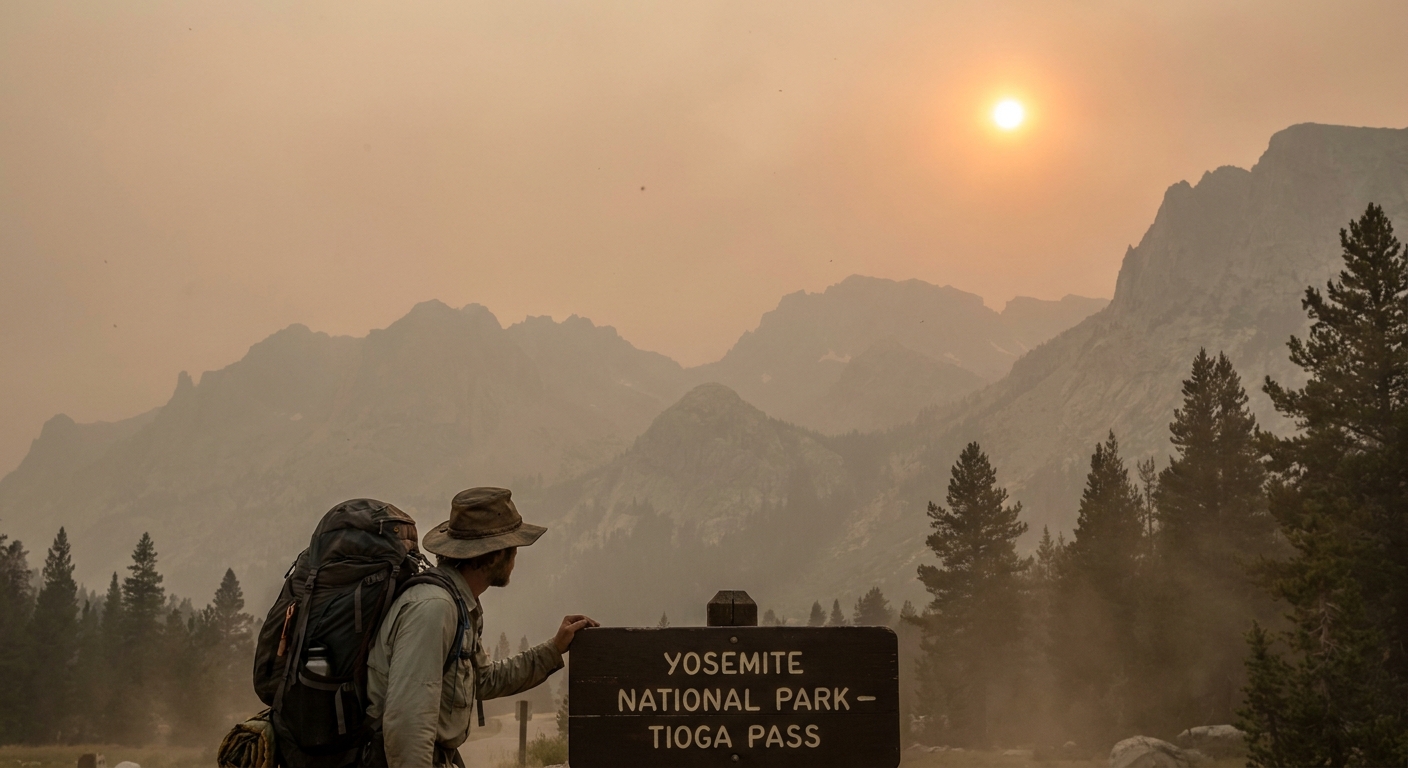
Some mornings in the West start with that campfire tang in the air, except nobody is roasting marshmallows. Your eyes itch in the parking lot. The ridgeline you came for looks like it was erased with a dirty sponge. On smoke days, the biggest hazard is not a cliff edge or a lightning strike. It is what you cannot see: fine particulate pollution that rides deep into your lungs, especially when you are hiking uphill and breathing hard.
This is the Town Wander approach to wildfire smoke: treat air quality like a trail condition. If you would check weather, snowpack, or a closure notice, you can check smoke too. Look up the numbers before you go, recheck if you regain service, and have an alternate plan ready so you can still have a great day in a national park gateway town without forcing a “summit at all costs” story.

Smoke 101
Wildfire smoke is a mix of gases and particles. For hiking decisions, the key metric is PM2.5, tiny particles that can slip past your body’s natural filters and irritate your lungs and cardiovascular system. The Air Quality Index (AQI) you see in apps is often driven by PM2.5 on smoke days.
Note: This article assumes US AQI (the one used by AirNow and many US weather apps). If you are in Canada or elsewhere, you may see a different index (like AQHI) with different categories.
Why exertion changes the risk
AQI is not just a “safe or unsafe” number. It interacts with what you are doing. Hiking means deeper breaths and more air moved per minute, which can mean more particulate intake compared with sitting in a café. That is why a day that feels “fine” at the visitor center can turn into a headache and coughing fit two miles into a climb.
Also, duration matters. A short stroll in Moderate air is one thing. Hours of steady uphill breathing in the same conditions is another.
Who should be extra conservative
- Anyone with asthma, COPD, or other lung conditions
- Heart disease or a history of stroke
- Pregnant travelers
- Kids and teens (smaller airways, higher breathing rates)
- Older adults
- Anyone currently fighting a cold, allergies, or a lingering cough
If you are in one of these groups, you do not need to “tough it out” to prove anything. The park will still be there. Your lungs have to come home with you.
AQI red flags for hiking
Different agencies phrase guidance slightly differently, but the practical takeaway for hikers is consistent: as AQI rises, reduce intensity, shorten duration, and avoid big climbs. Use the numbers below as a day-planning framework based on EPA-style categories and common public health guidance, then tighten your limits if you are sensitive or your trip involves long, steep exertion. If your local health department or the park posts stricter advice, follow that.
Quick thresholds
- AQI 0 to 50 (Good): Hike as planned.
- AQI 51 to 100 (Moderate): Most people can hike normally. If you are sensitive, pick a shorter route and avoid sustained steep climbs.
- AQI 101 to 150 (Unhealthy for Sensitive Groups): If you have asthma or heart or lung disease, skip strenuous hikes. For everyone else, consider swapping to a low-effort walk, viewpoints close to the car, or an indoor plan.
- AQI 151 to 200 (Unhealthy): Treat this as a strong “punt the big hike” signal. If you go out, keep it very short, very easy, and be ready to turn around fast.
- AQI 201 to 300 (Very Unhealthy): Skip outdoor exertion. This is when even healthy hikers can feel it quickly.
- AQI 301+ (Hazardous): Stay indoors with filtered air if possible. This is not a “wear a mask and send it” situation.
Two patterns that fool people
- Morning looks clear, afternoon tanks: Smoke can roll in with wind shifts, inversions breaking, or nearby fire activity. If your plan depends on “it’s fine at 7 a.m.,” build in a bail option.
- Valleys trap smoke: Inversions often hold the worst air low. Sometimes a higher elevation viewpoint is clearer, but do not assume. Check actual readings along your route.
How to check AQI
If you are staying in places like West Yellowstone, Gardiner, Springdale, Jackson, Moab, Estes Park, Mariposa, or Bar Harbor, you will notice locals do the same thing every morning in fire season: look at the sky, smell the air, then check the numbers.
Use at least two sources
- AirNow (good baseline, especially for official monitors and US AQI)
- PurpleAir (more neighborhood-level sensors, helpful near park edges and small towns)
- Your weather app (fine for a quick glance, but it can smooth over spikes)
Best practice: compare an official monitor reading with a nearby sensor network. On PurpleAir, look at the trend line for the last few hours, not just the current dot. If the app offers it, use an EPA correction (often labeled something like “US EPA” or “Woodsmoke”) so the numbers track more realistically during smoke events.
Check where you are actually hiking
Big parks have huge elevation ranges and microclimates. “Yosemite Valley AQI” may not match Glacier Point Road. “Zion Canyon” may not match Kolob Canyons. Pull up a map and check readings near your trailhead, your destination elevation, and your exit route.
Plan for no service
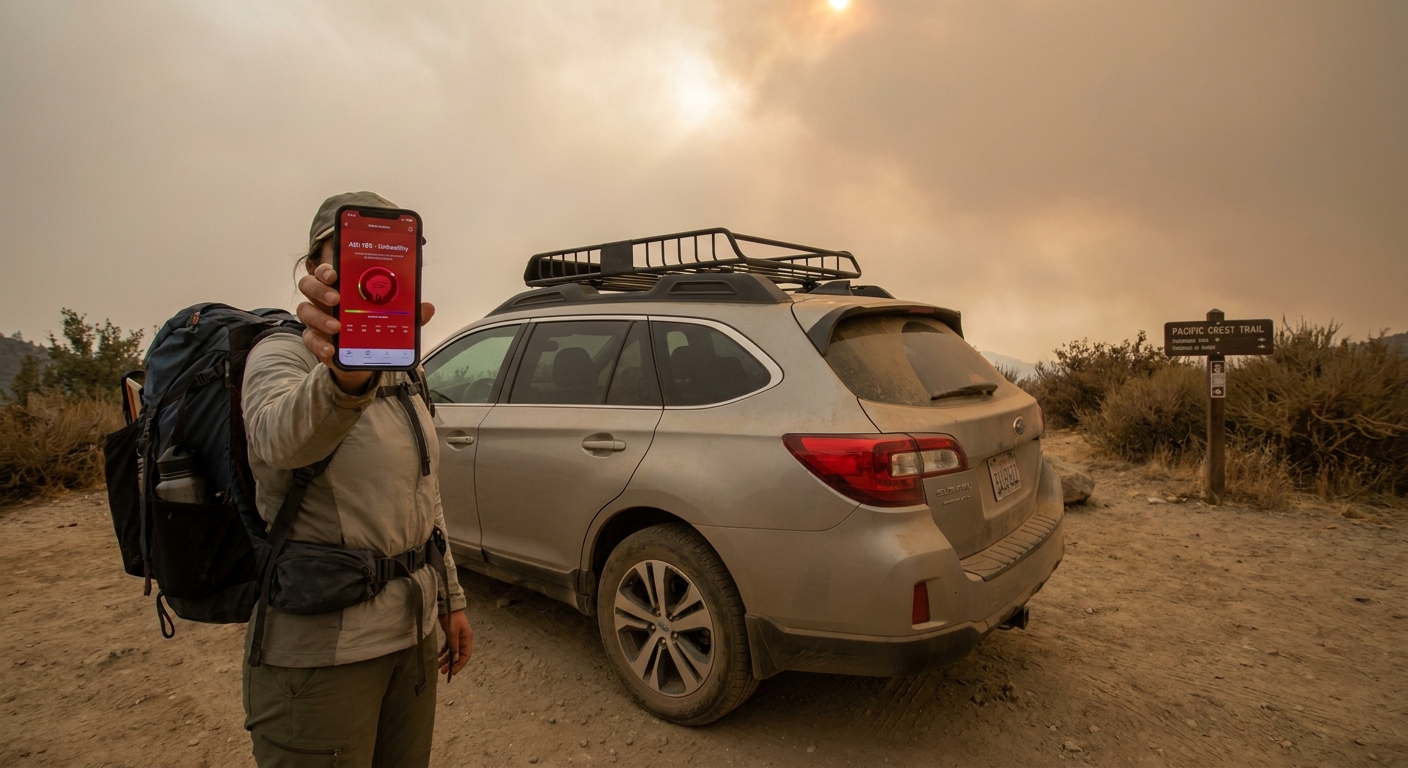
You will not reliably get updated AQI once you leave coverage. Before you head out, screenshot the current readings and the last 6 to 12 hours of trends for your trailhead area. If you regain service later, recheck and adjust.
When to turn around
Smoke is sneaky because it often worsens gradually, and hikers are great at normalizing discomfort. Decide your turnaround rules before you start.
Turn around if any of these happen
- You smell strong smoke consistently for more than a few minutes.
- New symptoms appear: burning eyes, scratchy throat, tight chest, unusual fatigue, headache, dizziness, nausea.
- Coughing starts or ramps up with exertion.
- Visibility drops enough that distant ridgelines disappear, or you lose a landmark you could see earlier.
- The trend is clearly worsening based on what you observed before you left service, or after you regain it.
Red flag symptoms
Seek medical care if you have shortness of breath at rest, wheezing, chest pain, blue lips or fingers, confusion, or symptoms that escalate quickly. If you carry a rescue inhaler and need it more than expected, that is also a strong sign to stop and get to cleaner air. For severe symptoms, follow local emergency guidance and call emergency services (911 in the US).
N95s on trail
If you are going to carry one smoke tool, make it a real respirator. Not all “masks” are created equal, and a lot of what people grab in a hurry does not meaningfully filter PM2.5.
N95 vs KN95 vs dust mask
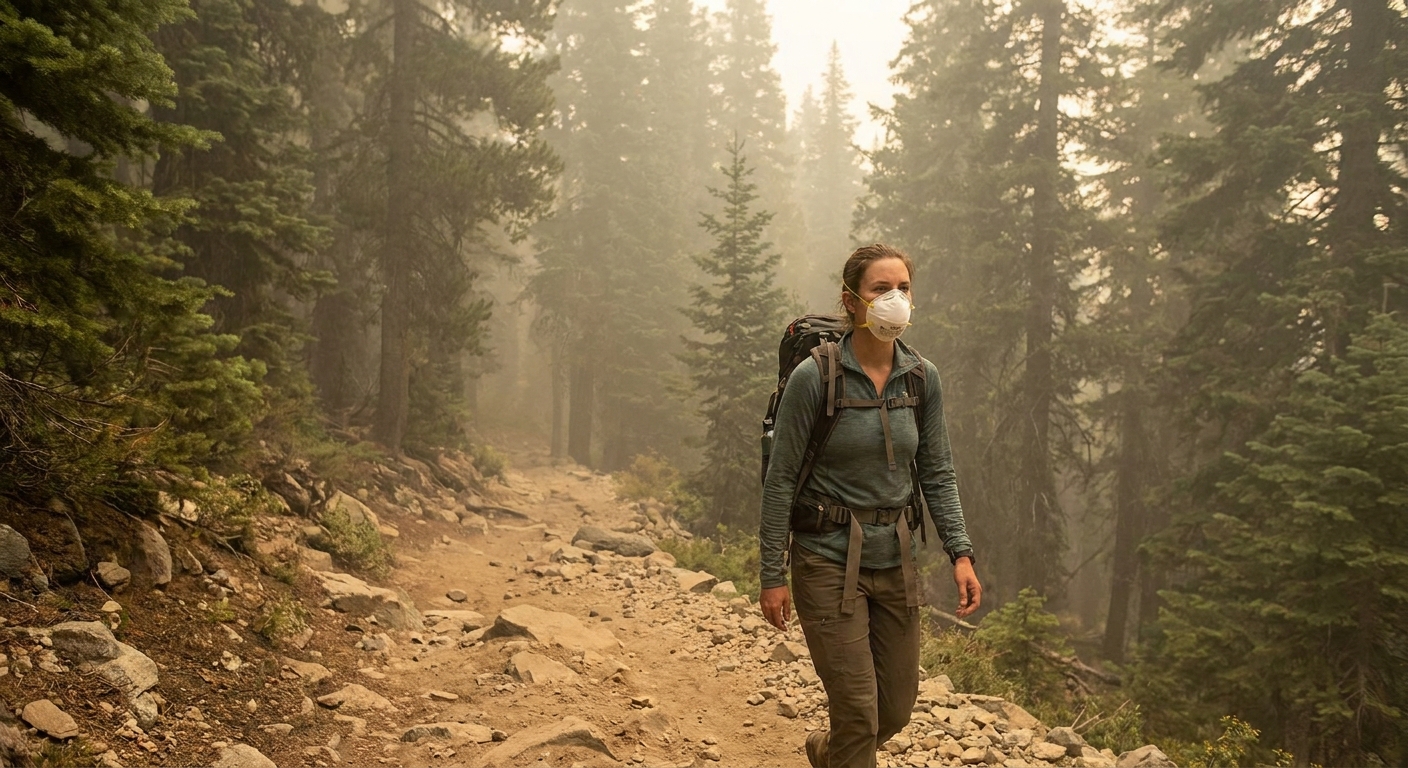
- N95 (NIOSH-approved): Certified by NIOSH to filter at least 95 percent of airborne particles when properly fitted. Best bet for wildfire smoke.
- KN95: Certified to a different standard (not NIOSH-approved). Some models work well, but quality varies. Fit is often the limiting factor.
- Cloth masks, bandanas, Buffs: Not reliable for PM2.5. Better than nothing for big ash, not for fine smoke.
- Simple dust masks: Often designed for larger particles. Many do not seal well and are not intended for smoke.
Fit is everything
An N95 only helps if air goes through the filter, not around the edges. Use these fit checks:
- Seal: Press the nose bridge, then inhale. The mask should pull slightly toward your face.
- Leaks: Exhale gently. If you feel air rushing up into your eyes, adjust or try another model.
- Facial hair: Beards break the seal. Even stubble can reduce effectiveness.
Can you hike hard in an N95?
Some people can, but many find it uncomfortable during steep climbs. Treat the mask as a risk reducer, not permission to do a strenuous hike in bad air. If you need a mask just to tolerate the trailhead, that is usually your clue to choose a different plan.
Carry-on only mask picks
- One or two NIOSH-approved N95s in a clean zip bag
- A spare for a travel partner or a ranger station donation box
- Optional: a small resealable bag for used masks so your pack does not smell like smoke all week
What to carry
My general rule is simple: if it weighs little and changes your decision-making, it earns a spot.
- Worth it: N95 respirator, eye drops (smoke can sting), extra water (dry air plus smoke feels dehydrating), a plan for a quick exit.
- Maybe: A compact inhaler spacer if prescribed, saline nasal spray for comfort, a small pulse oximeter if you have a health condition and know how to interpret it.
- Not worth it as a “solution”: Cloth face coverings for smoke, essential oils, “detox” drinks, or anything that makes you feel like you can outsmart physics.
Make indoor air cleaner
If smoke is hanging around, your “adventure move” might be building a clean-ish air bubble so you can sleep, recover, and try again tomorrow.
- In a car: Windows up, set air to recirculate. Limit in and out time at viewpoints when AQI is high.
- In a hotel or rental: If you have AC, keep windows closed and run it. Ask about filtration if you can. Some places will have portable HEPA units on hand during bad weeks.
- HEPA purifier: A true HEPA air purifier can help a lot in a bedroom sized space.
- DIY box-fan filter: If you do this, follow reputable instructions, keep it stable, and do not leave it unattended. Safety first.
How to punt the park day
Calling an audible is not quitting. It is good backcountry judgment applied to a very modern hazard. The trick is to have a Plan B that still feels like a trip, not like you got grounded.
Option 1: Go easy outdoors
If AQI is borderline and stable, swap the big hike for something that keeps your breathing calmer:
- Short nature trails near the entrance
- Scenic drives with quick viewpoint stops
- Riverside walks where you can turn around anytime
- Sunrise or early morning strolls if the trend is best then
Keep it honest: if you are still coughing on a flat walk, move indoors.
Option 2: Chase cleaner air
Sometimes air is better on the coast, after a wind shift, or in a different valley. Before you drive, confirm with real-time monitors along the route. A two-hour reposition can save a trip, but only if you are driving toward genuinely better readings.
Option 3: Build a gateway-town indoor day
Western park towns are better than people expect at smoke-day salvages. Look for places with good filtration and a reason to linger.
- Museums and cultural centers: Tribal museums, regional history museums, photography galleries, ranger-led indoor talks when available.
- Local coffee shops: Pick one with seating, order something slow, and actually read the book you packed.
- Food halls and markets: Ideal for grazing without committing to a long outdoor wait.
- Libraries and bookstores: Underrated travel MVPs, especially in small towns.
- Visitor centers: Great for geology displays and next-day strategy with staff who know the latest closures.

Park logistics
Closures and alerts
Smoke often overlaps with fire activity, and that can trigger trail closures, road closures, and evacuation warnings that change fast. Check:
- The park’s official website and social channels
- NPS app alerts (where applicable)
- State or county emergency updates if you are near a fire perimeter
If a ranger tells you to avoid an area, treat it like a hard rule. They are balancing more than your view, including firefighter access and changing wind behavior.
Driving in smoke
- Use headlights in low visibility.
- Keep extra following distance.
- Do not stop on road shoulders where visibility is poor.
- If ash is falling, be cautious. Roads can get slick, especially when wet.
Itinerary swaps
Here are simple swaps that keep the spirit of your trip while lowering the lung load.
- Big climb to alpine lake → lake overlook near a pullout plus a picnic in the car with windows up
- All-day canyon hike → short river walk then a long lunch and a museum stop
- Ridgeline trek → scenic drive timed for the clearest hour of the day
- Peak-bagging → town wandering in a historic district, gallery row, or local market
Yes, it is different. It is also how you end up discovering the one bakery everyone in town swears by, the tiny exhibit on local ecology, and the quiet corner coffee shop that becomes the memory you talk about months later.
Smoke-day checklist
- Check US AQI now and the trend for the last 6 to 12 hours
- Check AQI at the trailhead area, not just the town you slept in
- Decide your exertion level based on AQI (and be more conservative if sensitive)
- Screenshot readings before you leave service
- Pack an N95 and test the fit before you need it
- If you do not have an N95, do not rely on cloth. Prioritize relocating or going indoors
- Set a turnaround rule tied to symptoms and visibility
- Confirm closures, advisories, and road conditions
- Choose a Plan B indoor or low-effort option before you leave service
Frequently asked questions
Is it better after rain?
Sometimes. Rain can knock particles down, but the effect can be temporary and smoke can also linger under an inversion. Check the readings, not just the forecast.
Does a car cabin protect you?
It can help if windows are up and the cabin air is set to recirculate, especially in newer vehicles with decent cabin filters. It is not a perfect clean room, but it is often better than standing outside at a viewpoint in heavy smoke.
What about hiking near waterfalls or rivers?
Water does not magically filter smoke from the air. A shady riverside stroll can feel easier because it is less strenuous and cooler, but AQI still rules the risk.
If I cannot see smoke, is it safe?
Not always. PM2.5 can be elevated even when the horizon looks decent. Trust monitors and symptoms, not just the view.
Bottom line
Wildfire smoke is a real trail condition, and the smart move is to plan around it like you would lightning or extreme heat. Use AQI to set your exertion limits, carry an N95 that fits, and give yourself permission to punt the big hike. A smoke-day pivot can still be a perfect travel day, just one with more espresso, fewer switchbacks, and lungs that still feel like yours tomorrow.
If you want official public health guidance to compare against your plan, start with AirNow and EPA wildfire smoke resources.