Maple Pass Loop: Best Season, Parking, and Passes
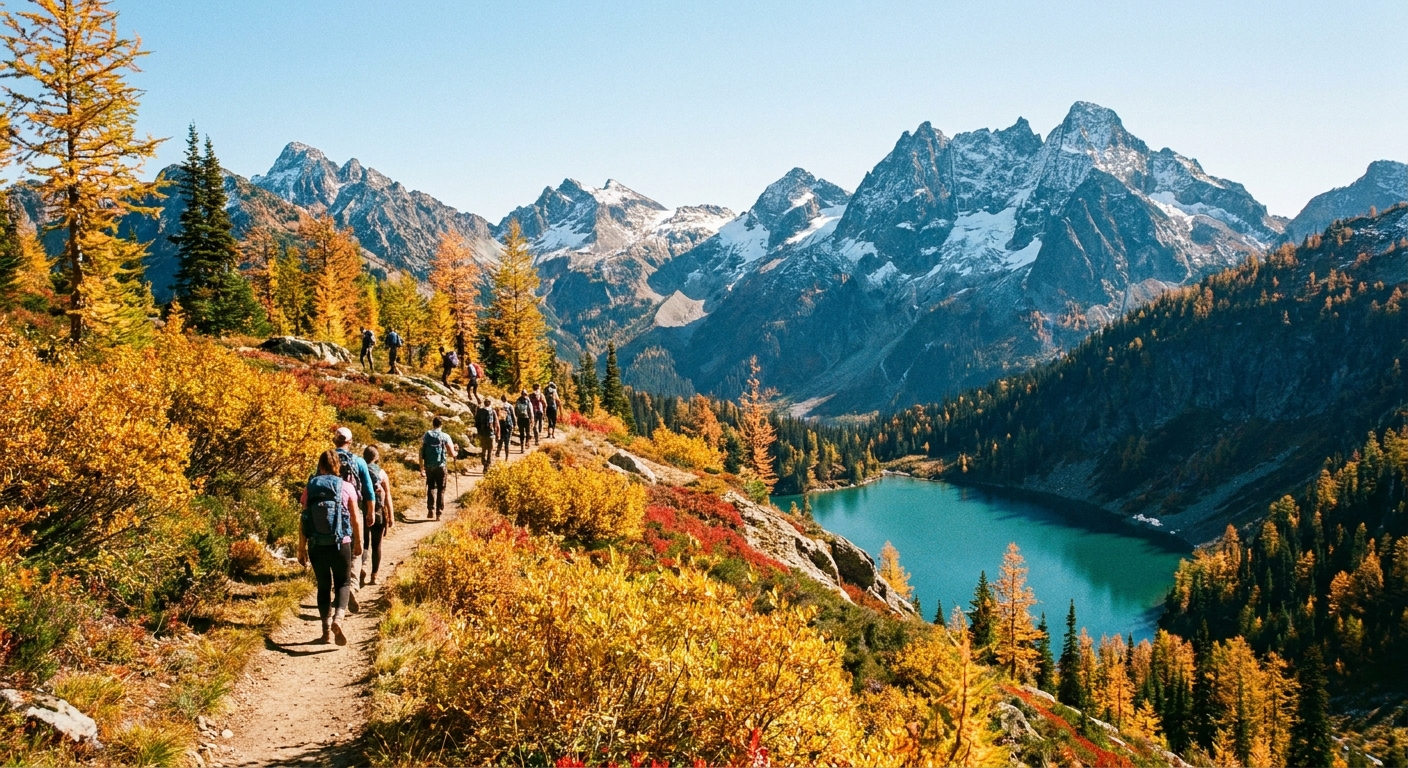
Maple Pass Loop is one of those North Cascades hikes that somehow manages to feel wildly alpine while still being logistically easy to pull off. In roughly seven-ish miles you get subalpine fall color, peak-to-peak views for long stretches, and a ridge walk that feels bigger than the mileage suggests. The tradeoff is that it is popular, weather sensitive, and very seasonal.
This guide is the “when and how” companion to Town Wander’s broader North Cascades and Diablo Lake coverage, with the nitty-gritty details people actually need: when snow finally lets go, what to do about the parking lot on a bluebird October weekend, how to layer for the pass, what pass you need on your dashboard, and what to hike instead if wildfire smoke or a fast-moving storm shuts down your Plan A.

Maple Pass Loop at a glance
- Trailhead: Maple Pass Loop at Rainy Pass (off Highway 20 / North Cascades Highway)
- Distance: about 7 to 7.5 miles (loop, depending on device and side trips)
- Elevation gain: about 2,100 to 2,300 feet (varies by GPS track)
- Time: 4 to 6 hours for most hikers, longer with lots of photo stops
- Difficulty: moderate to moderately strenuous (sustained climb, exposed ridge sections)
- Facilities: pit toilets near the trailhead
- Water: no reliable potable water on trail. If you draw from Lake Ann or seasonal trickles, treat or filter it.
Loop direction: Both directions work, but many people prefer counterclockwise (up through the forest toward Maple Pass, then along the ridge, then down past Lake Ann). It tends to give you a steadier climb and a more gradual descent, plus the “wow” views keep arriving instead of peaking all at once.
Permits and passes
Do not skip this part. The Rainy Pass trailhead is on U.S. Forest Service land and typically requires a Northwest Forest Pass (or an America the Beautiful interagency pass) displayed in your vehicle.
- What usually works: Northwest Forest Pass, America the Beautiful pass
- Good habit: check the current trailhead page or recent trip reports before you go, since requirements and signage can change
Best season
The North Cascades are not a “three-season” hiking destination in the same way as some lower, drier mountain regions. Here, snowpack and freeze-thaw cycles control the calendar. The single biggest factor is lingering snow on the pass and the steep slopes below it.
Late June to July
Some years, you will see hikers on Maple Pass in late June. Other years, it is a hard no without snow travel skills. Expect patchy snowfields, sloppy runnels, and sections where the trail is buried on shaded slopes.
- Pros: fewer crowds, dramatic snow-and-rock scenery, waterfalls and saturated greens
- Cons: higher risk of losing the trail, steep snow crossings, colder wind on the ridges
- Bring: traction (microspikes) if recent trip reports mention snow, and trekking poles for stability
Early-season reality check: firm morning snow can be slick. Microspikes are great, but they are not magic. If trip reports mention steep traverses, runout exposure, or hard snow, this can move into ice-axe and self-arrest territory for some hikers. If you are not sure, pick a lower-risk backup that day.
August to mid September
If you want the best balance of clear trail, long daylight, and a decent chance at stable weather, this is it. Trail is usually snow-free, the ridge is dry, and visibility can be spectacular.
- Pros: typically snow-free, easiest navigation, long days
- Cons: wildfire smoke risk increases in late summer, weekends are busy
Late September to mid October
This is Maple Pass celebrity season. Subalpine shrubs and plants go fiery, light gets softer, and the air often feels crisp without being wintery. It is also the time when the parking lot behavior becomes the main plotline of your day.
- Pros: incredible fall color, comfortable hiking temps, photogenic lighting
- Cons: packed weekends, early storms possible, icy mornings
Late October to May
Once winter storms settle in, Maple Pass becomes a different outing that can require avalanche awareness, route-finding, and winter gear. Highway 20 also typically closes for winter at a seasonal gate (closure points vary year to year), which usually prevents driving access to Rainy Pass.
Snow lingering by month
If you are planning from afar, the simplest way to think about Maple Pass is: it is a high pass hike with a short summer. Snow lingers longest on north-facing slopes and in shaded traverse sections, even when the trailhead feels like spring.
- June: often continuous snow near the pass in heavier snow years
- July: transition month, could be clear or could still have lingering snowfields
- August: usually clear, occasional tiny patches in shaded spots
- September: clear trail, colder mornings
- October: clear early, then watch for first snow dustings and icy sections
How to sanity-check conditions: look for recent trip reports specifically mentioning “Maple Pass” and “Rainy Pass,” and cross-check with the forecast for Rainy Pass elevation. When a report says “snow-free,” it usually means “no problematic snow crossings,” not “you will not step on a single patch of snow anywhere.”
Route basics
Maple Pass Loop starts from the Rainy Pass trailhead and quickly reaches the junction where you choose your loop direction. Counterclockwise sends you uphill first, then along the ridge, then down toward Lake Ann (with views and a chance to take a short spur to the lake if you want). Clockwise flips that.
This is not a complicated trail in summer conditions, but it is still worth downloading an offline map. Fog or snow can make the “obvious” path less obvious.
Cell service: expect it to be spotty to nonexistent. Plan like you will not have signal.
Parking at Rainy Pass
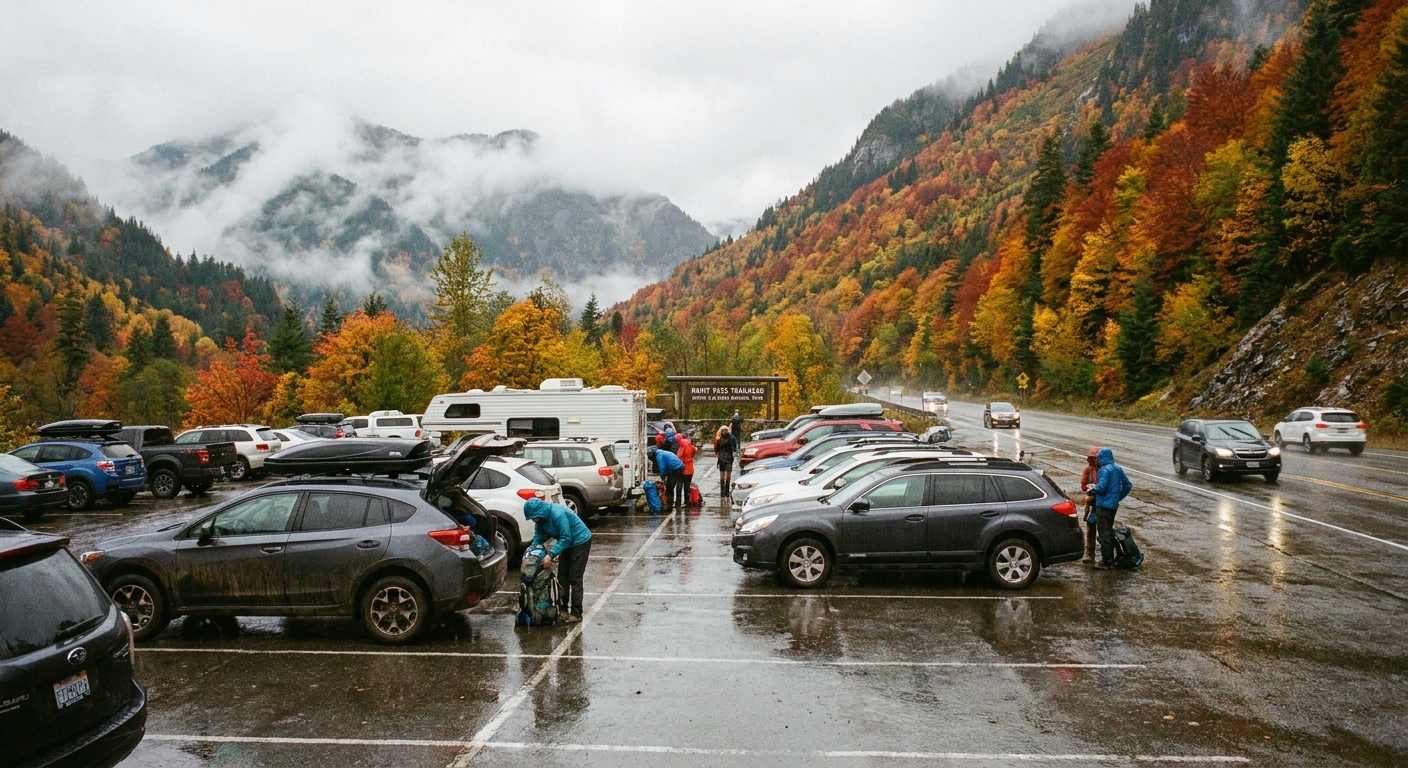
The Rainy Pass trailhead serves multiple high-demand hikes, and Maple Pass is the headline act. On sunny weekends in late September and October, the lot can fill shockingly early. Plan for it like you would plan for a concert, not a casual stroll.
When to arrive
- Best bet: arrive before 8:00 a.m. on peak fall weekends
- Still workable: 8:00 to 9:30 a.m., but expect delays and creative parking
- Risky: after 10:00 a.m. on a bluebird Saturday
If you show up late, you may see cars lining the highway shoulders. Do not assume this is allowed or safe. Highway 20 has fast traffic, and shoulder parking can be restricted or dangerous depending on the exact area and conditions.
Strategies that help
- Go midweek if you can. Even a Friday can feel significantly calmer than a Saturday.
- Start earlier, finish earlier. Ridge hikes are better before afternoon wind and clouds build anyway.
- Have a backup hike picked out within a short drive so you can pivot without spiraling.
Facilities note: there are toilets at the trailhead, but bring your own hand sanitizer and plan for lines on busy days.
Weather reality
Even in summer, Maple Pass feels like a mountain pass because it is one. The ridge is exposed, wind can be sharp, and weather changes can be quick. I have started in a calm, mild forest and hit a pass-level gust that made me grateful for every extra layer in my pack.
Common conditions
- Summer (August to early September): warm trailhead temperatures, cooler and breezier on the ridge. Afternoon clouds can build.
- Fall (late September to October): crisp starts, big temperature swings, higher chance of fast-moving fronts and early ice.
- Smoke season: visibility can go from “endless horizons” to “milky haze” quickly, and exertion feels harder.
What “bad” weather looks like
- Wind: sustained wind on exposed ridge sections can make footing feel less stable.
- Low cloud: the ridge can disappear into fog, reducing views and making the trail feel more committing.
- Cold rain: not usually dangerous by itself, but it becomes a problem when paired with wind and poor visibility.
- Isolated thunderstorms: not the norm here like in some mountain ranges, but they can happen. An exposed ridge is not where you want to be if lightning is in play.
My rule: if the forecast calls for strong wind at pass elevation, or a significant chance of heavy rain or lightning, Maple Pass stops being “fun scenic ridge walk” and starts feeling like “endurance with less reward.” That is when backup plans shine.
Layers and gear
This is a hike where a carry-on only traveler still needs a real layering system. The ridge is exposed, and a sunny forecast can still mean a cold, windy pass.
Clothing layers
- Base: moisture-wicking top (avoid cotton if you can)
- Mid: light fleece or active insulation
- Shell: rain jacket that blocks wind
- Extras: beanie or headband and light gloves in fall
Footwear and stability
- Trail runners or hiking boots: both work when trail is dry. Choose what you trust on steep descents.
- Trekking poles: helpful for the descent and for any lingering snow or slick fall leaves.
- Microspikes: can be a game changer in early-season snow or icy shoulder-season mornings, but only bring them if recent conditions suggest you will need them.
Food, water, and the small stuff
- Water: bring enough from the car. Treat or filter if you take water from Lake Ann or seasonal streams.
- Sun protection: sunglasses and sunscreen. Even on hazy days, UV can be strong at elevation.
- Navigation: download an offline map.
- Headlamp: especially in October when daylight is shorter and parking may delay your start.
If you are only going to add one “just in case” item to your pack for Maple Pass, make it a wind-blocking layer. The pass has a way of humbling optimism.
Wildfire smoke plan
Late summer and early fall in Washington can mean smoke. Maple Pass is all about views, so smoke can turn a dream hike into a gray treadmill with pretty shrubs.
Decision checklist
- Air quality: if AQI is poor where you are staying, it can be worse at the pass. Hiking hard in smoke is rough on your lungs.
- Visibility: if webcams and recent photos show washed-out horizons, the ridge payoff may be minimal.
- Health: if you have asthma or are traveling with kids, err on the conservative side.
Backup approach: pivot to forested, lower-elevation walks where you are not relying on distant views. The goal becomes fresh air and a pleasant day, not a panorama.
Backup hikes
If you wake up to driving rain, low clouds sitting on the pass, or a forecast that screams “windy ridge,” you do not have to scrap the day. Here are shorter, more protected alternatives that still deliver a North Cascades fix. Always check current access and conditions before you go, especially late in the season.
Rainy Lake
Rainy Lake is close to the same area and is a solid choice when you want a low-commitment outing. It is shorter, lower-angle, and often feels calmer in sketchier weather.
- Why it works: you still get that crisp mountain-lake payoff without committing to the ridge
- Best for: families, recovery legs, stormy days
Washington Pass Overlook
If conditions are not great for a long hike but visibility is decent, the Washington Pass Overlook can be a perfect “coffee stop with a view” kind of moment. It is short and dramatic.
- Why it works: minimal exposure time, maximum scenery if clouds cooperate
- Best for: storm dodging, sunset or quick morning stop
Blue Lake
Blue Lake is another high-reward trail in the area with a shorter commitment than Maple Pass. It can still be busy, but it is less ridge-exposed than Maple Pass and offers a defined destination.
- Why it works: lake payoff, easier to turn around if weather deteriorates
- Best for: days with mixed clouds, or when you want alpine vibes without the full loop
Extra backup idea: If smoke is bad up high but conditions are calmer lower down, consider a town-forward day: a slow lunch stop, a local coffee shop hunt, and a scenic drive with short viewpoints. In the North Cascades, “Plan B” can still feel like a trip highlight.
Day-of game plan
For peak fall weekends
- 6:00 to 7:00 a.m.: coffee and breakfast, pack lunch and layers
- 7:30 to 8:00 a.m.: arrive and park, bathroom stop, final gear check
- 8:00 a.m. to 2:00 p.m.: hike the loop with long breaks on the ridge and at Lake Ann viewpoints
- 2:00 to 3:00 p.m.: late lunch at the car, then consider a short scenic drive stop before heading back
For summer weekdays
You have more flexibility. Still, an earlier start gives you cooler temps on the climb and calmer trail vibes.
Leave no trace
Because Maple Pass sees so much foot traffic, small decisions add up quickly.
- Stay on the trail to protect fragile alpine plants, especially during fall color season when off-trail photos are tempting.
- Pack out everything including food scraps. The “it will biodegrade” logic does not hold up in alpine environments.
- Give people space on narrow ridge sections. Step aside on durable surfaces and avoid trampling vegetation.
- Dogs: keep dogs on a leash and under control. Be extra mindful near wildlife and around nervous hikers on narrow sections.
- Wildlife awareness: give animals room, do not feed them, and store food securely (even on day hikes) so you are not training critters to approach people.
Quick FAQ
Is Maple Pass Loop worth it if I only have half a day?
Yes, if you can start early. The loop is very doable in half a day for many hikers, but only if parking does not eat your morning and you move steadily.
Which direction is better?
Counterclockwise is a popular choice for a more gradual descent and steady payoff. Clockwise is also great if you prefer a steeper climb early and a gentler finish.
When is the best chance for fall color?
Usually late September into early October, but timing shifts each year with weather. Aim for that window and stay flexible by a week if you can.
What is the number one reason people have a bad day on Maple Pass?
Underestimating exposure. A calm forecast at the trailhead can still mean wind and chill on the ridge. Pack the wind layer and you will feel like a genius up top.
Pair it with Diablo Lake
If Maple Pass is your “mountain high,” Diablo Lake is the perfect “glacier-water glow” counterbalance. Many travelers combine Maple Pass in the morning with a Diablo Lake viewpoint stop later, when the light is bright and the water color pops. If you are building a North Cascades weekend, that rugged-plus-comfort combo is exactly why this corner of Washington is so addictive.