Peekaboo and Spooky Slot Canyons: Dry Fork Loop
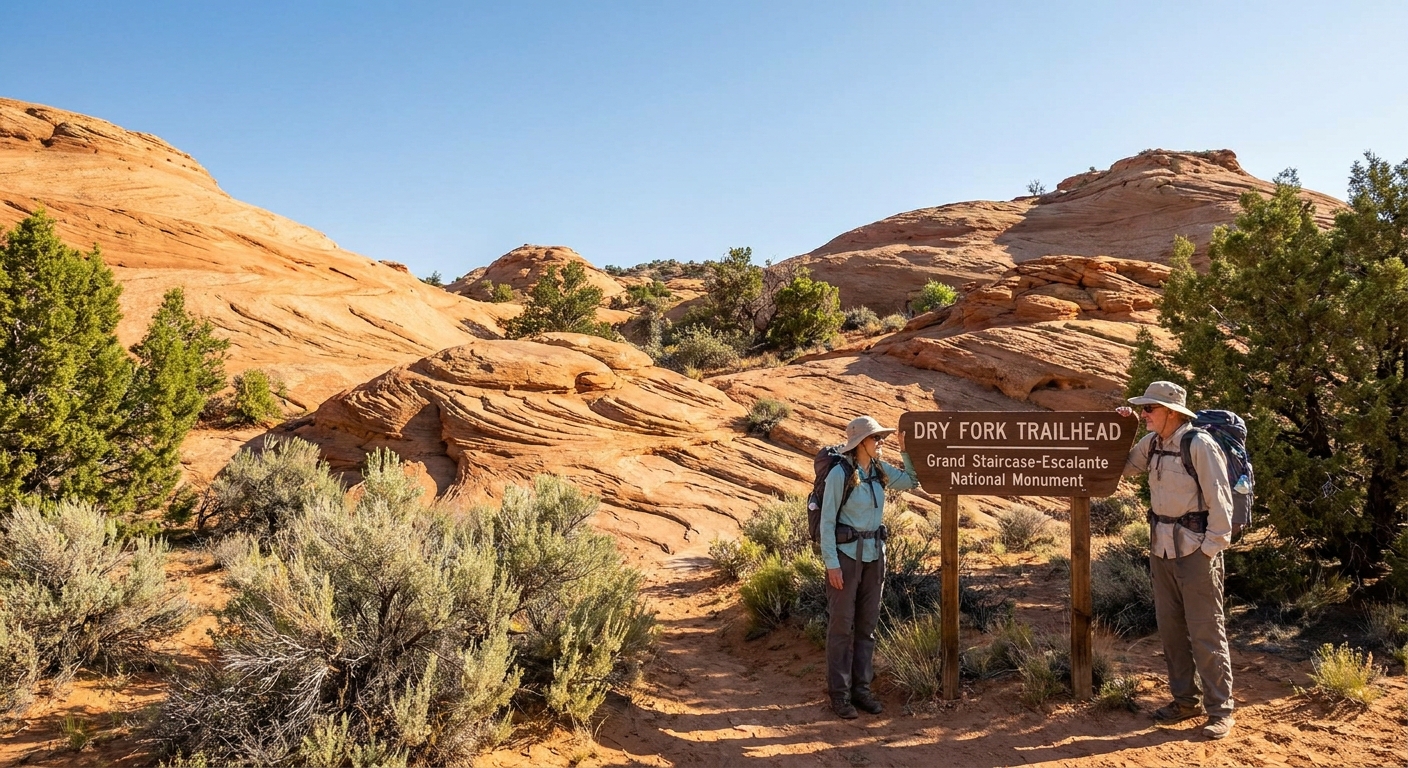
Peekaboo and Spooky are the kind of Utah slot canyons that make you whisper without meaning to. Not because they are haunted, but because the walls lean in close enough to steal your echo, and the light does that sandstone magic trick where it turns ordinary minutes into a highlight reel.
They are also the kind of hike that punishes bad timing. A little rain can turn the access road into a clay skating rink. A storm miles away can send a flash flood through a canyon that feels bone dry. And if you linger too long shooting photos in the narrowest sections, you can end up hiking back out in the dark.
This guide is built for a single-day trip from Escalante: Dry Fork trailhead logistics, the BLM-recommended one-way loop that links both slots, when ropes and mud matter, and the very specific situations where you should skip the slots entirely.

Quick facts
- Start: Dry Fork trailhead (off Hole-in-the-Rock Road)
- Route: Dry Fork wash to Peekaboo and Spooky, commonly done as a loop using the wash connector
- Distance: Roughly 3.5 to 4.5 miles total for the standard Peekaboo + Spooky loop, depending on wandering, backtracking, and how far you explore each slot
- Time: 2.5 to 5 hours for most hikers, longer if you photograph slowly or wait for groups
- Difficulty: Moderate, with scrambling, tight squeezes, and short downclimbs
- Best seasons: Spring and fall for cooler temps; winter can be icy in shaded narrows; summer is workable early, but watch monsoons
- Permits and fees: Typically no permit for self-guided day hiking here, but policies can change. This area is within Grand Staircase–Escalante National Monument (BLM). Before you go, check the official BLM GSENM updates for current conditions, road status, and any parking or day-use fees that may apply.
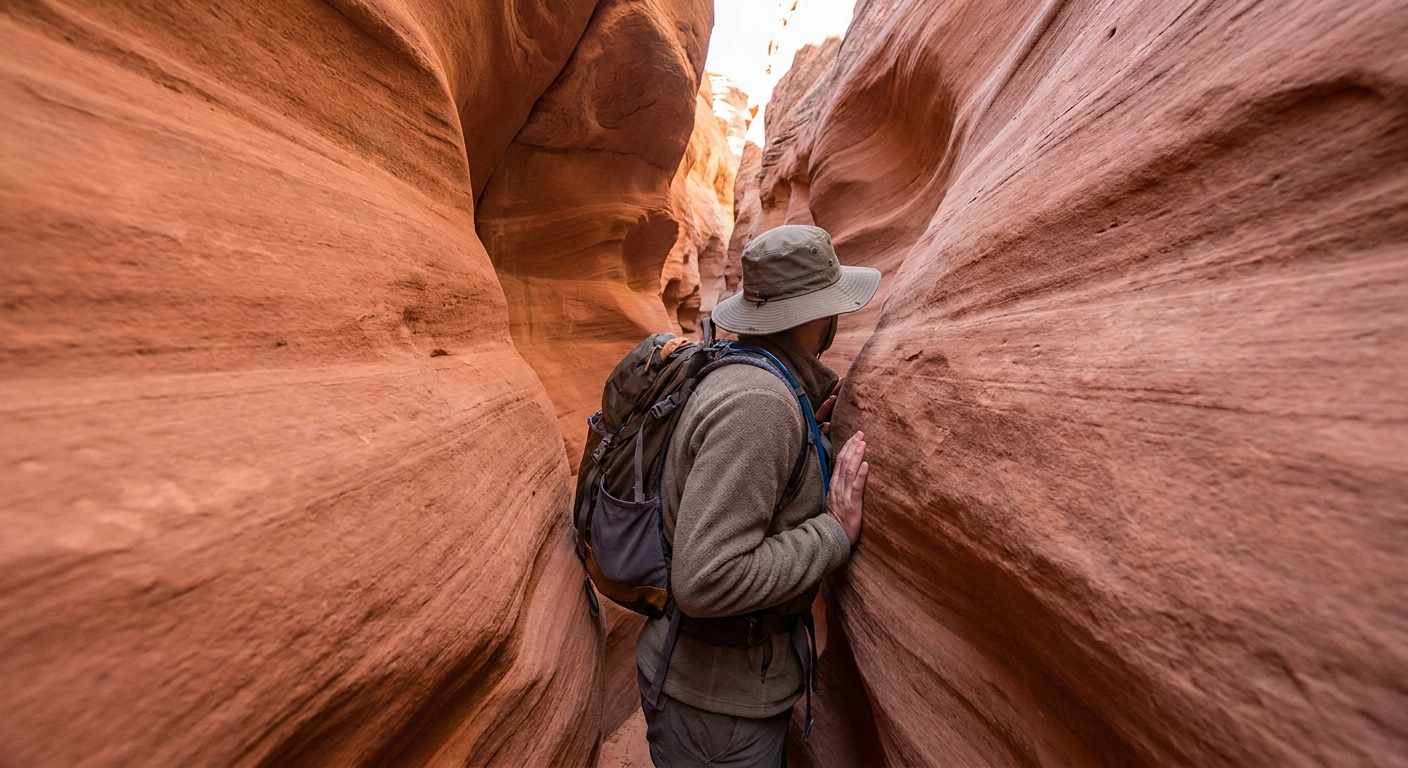
Reality check: “Spooky” is narrow. The tightest squeezes are often around 10 inches wide (it varies with sand and obstacles). If you are uncomfortable with tight spaces, have broad shoulders, carry a large pack, or are not sure about your mobility in a squeeze, it is completely okay to do Peekaboo only and call it a great day.
Getting to Dry Fork trailhead
From Escalante
Drive east on UT-12, then turn onto Hole-in-the-Rock Road (the well-known, washboarded dirt road south of town). Dry Fork trailhead is a signed turnoff. Plan on roughly 30 to 40 minutes of driving from Escalante in dry conditions, plus extra if the washboards are bad.
Heads up: Cell service is unreliable out here. Download offline maps before you leave town.
Road conditions that matter
Hole-in-the-Rock Road is often passable for many passenger cars when it is dry, but the real problem is wet clay. When it rains, the road can become impassable and dangerously slick even if you have 4WD. The Dry Fork spur can also get rutted.
- If rain is in the forecast: consider switching to a paved-road plan (Escalante has plenty of options) and save the slots for a dry day.
- If it rained in the last 24 to 48 hours: ask locally in Escalante about current road conditions. Local intel beats wishful thinking.
Parking and what to bring to the trailhead
- Arrive early: mid-morning can get crowded, especially in peak seasons.
- No water at the trailhead: bring what you need.
- Toilets: conditions vary; do not count on services. Pack out all trash, including food scraps.
Route: the safer loop
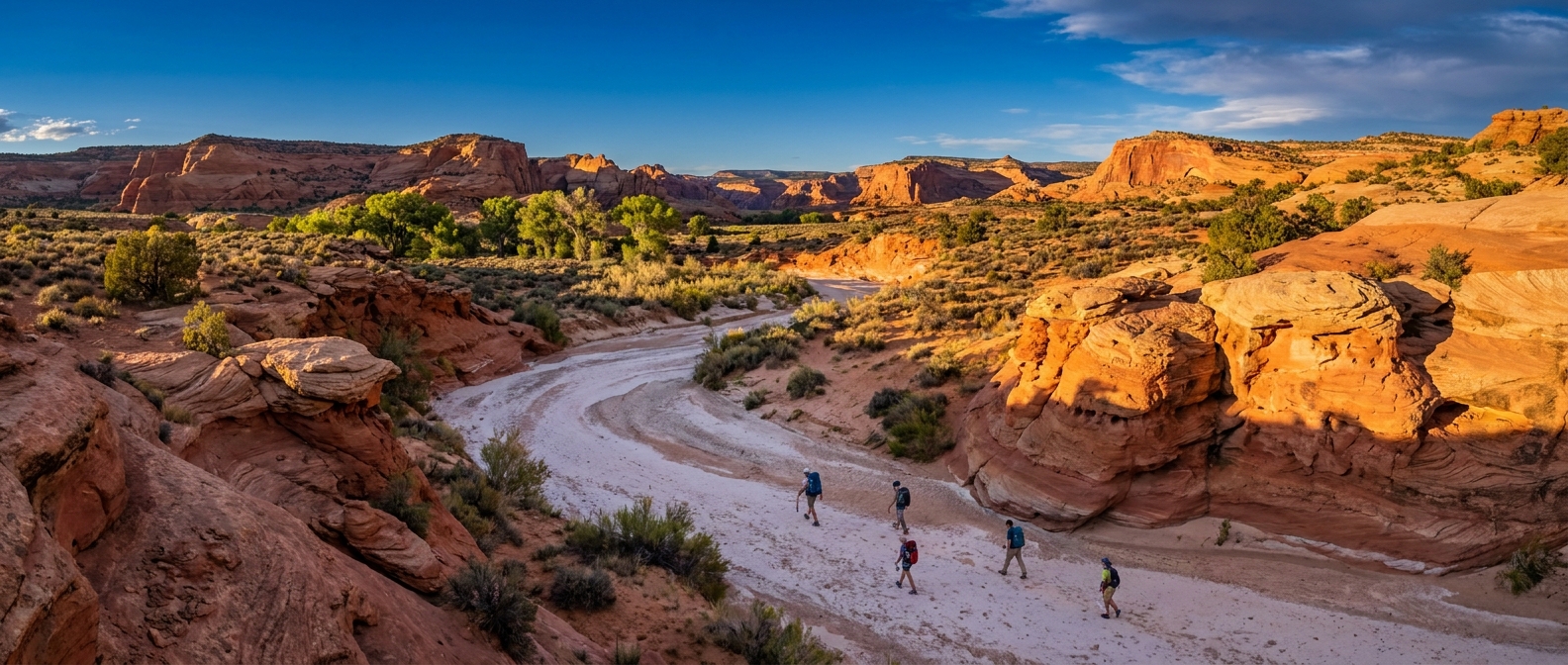
The hike begins with a descent from the trailhead down into Dry Fork wash. From there, you have three named slot canyons in this area: Peekaboo, Spooky, and Brimstone. Most people pair Peekaboo and Spooky. Brimstone is more technical and is often left to experienced parties.
Navigation note: Once you are in the wash, signage is minimal and there are multiple social paths. If you do not know this area, a downloaded map or GPS track helps you avoid unnecessary wandering.
BLM-recommended one-way flow
The common guidance here is Peekaboo first, Spooky second. It is not just “efficient.” This one-way flow is widely recommended because it helps reduce head-on meetups in narrow sections and lowers the odds of stressful, potentially dangerous bottlenecks.
- Hike down to Dry Fork wash. Follow the main wash as it opens and bends.
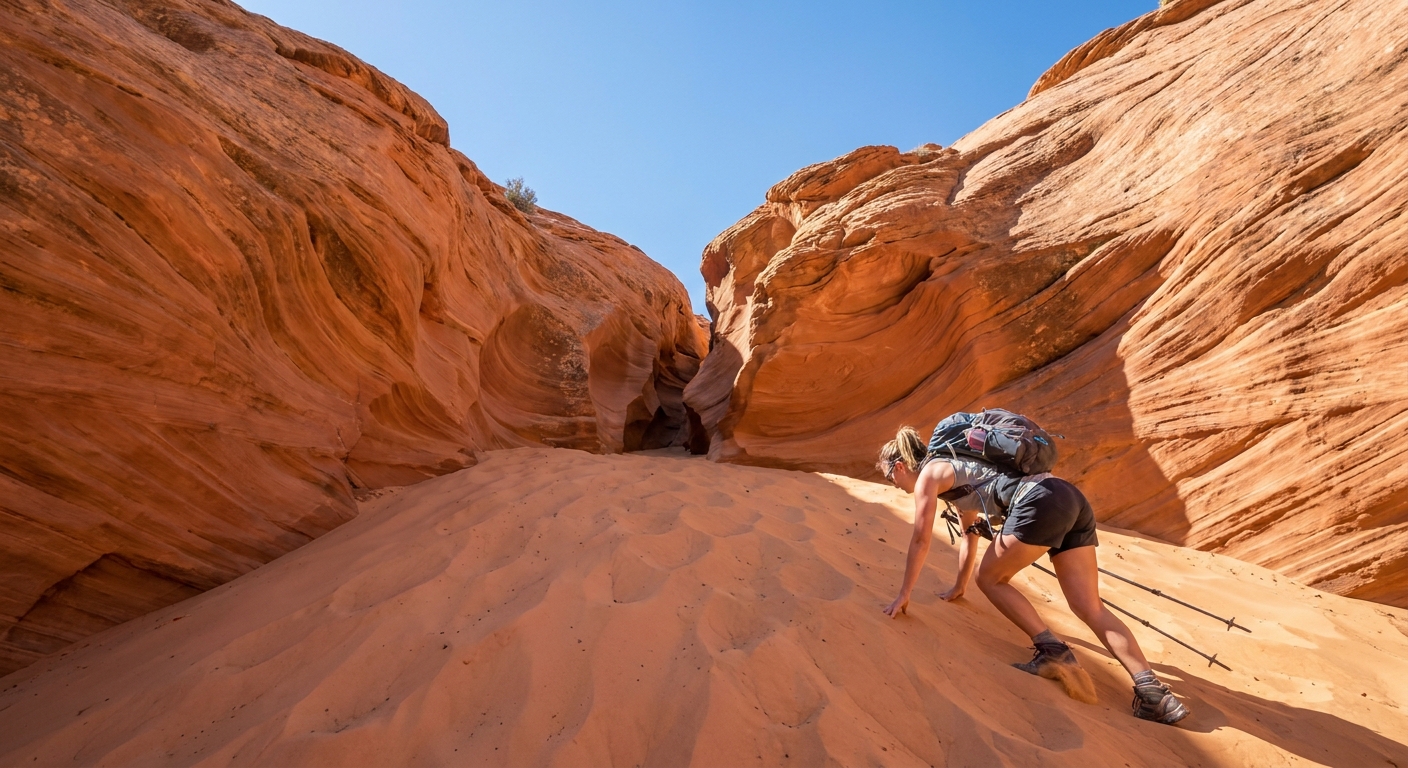
- Enter Peekaboo first. The entrance usually involves scrambling up a short, sandy slope and navigating a few rock steps.
- Complete Peekaboo, then return to the wash. You will exit back out to a broader area.
- Use the wash connector to reach Spooky. Follow the wash toward Spooky’s obvious, darker slot opening.
- Go through Spooky end-to-end. You enter one end and exit the other, then return via the wash.
- Hike the wash back to the trailhead climb. The exit climb is short but feels real in midday heat.
Why this order works: Peekaboo’s scrambles and “fun obstacles” feel easier with fresh legs. Spooky’s squeezes and downclimbs feel calmer when you are already warmed up to the terrain. And keeping traffic moving in one general direction is a big deal in a canyon that can narrow to body width.
Mud, ropes, and obstacles
Mud: messy vs no-go
There is “slot canyon mud” that just means dirty knees, and then there is “turn around” mud.
- Manageable mud: damp sand, minor puddles, sticky shoes. You move slower, but you are fine with patience.
- No-go mud: standing water you cannot see the bottom of, deep muck that grabs calves, or mud that makes downclimbs feel unsafe. In narrow slots, you cannot always detour around it.
After rain, skip the slots if: you see fresh water staining high on the walls, hear rushing or dripping that does not match what you can see, notice fresh debris piled in odd places, or feel damp airflow that suggests water recently moved through. Any one of those is a good reason to pivot.
Do you need a rope?
Most hikers do Peekaboo and Spooky without a rope. That said, conditions change. Sand moves, logs shift, and the “easy” downclimb can look different from one season to the next.
- Peekaboo: has a few short scrambles and drops that may feel easier with a handline for some groups.
- Spooky: is less about vertical drops and more about tight, twisting squeezes and short downclimbs that demand body positioning.
If your group includes kids, new scramblers, or anyone uneasy with downclimbing: a short, lightweight handline can add comfort. Just do not rely on it as a substitute for judgment. In a slot, once you are deep in, your options can shrink quickly.
Pack size matters
For Spooky especially, go small. My carry-on-only brain loves this hike because it rewards minimalism.
- Use a small daypack that can slide through narrow spots (or be removed and pushed ahead).
- Stow water in a way that does not snag.
- Avoid tripods in the tightest sections unless you love awkward shuffling.
Flash floods: red flags
Flash floods are the headline hazard in slot canyons. The tricky part is that you can have blue sky above you and still be in danger if rain is falling upstream.
Do not enter when
- Thunderstorms are forecast anywhere in the drainage. Look beyond “Escalante weather” and check regional radar.
- You see tall clouds building fast. Summer monsoon patterns can pop quickly.
- The wash shows fresh debris lines. Sticks and grass wedged above head height are a clue that water recently moved with force.
- Water is already flowing in the wash. Even a small flow can become dangerous inside narrows.
If you are unsure, do this instead
Choose an open hike where you have easy escape options, or pivot to a town day in Escalante. A slow coffee morning and a local lunch beats making a bad call in a slot.
If you would not be comfortable betting your phone, your camera, and your ankles on the forecast being “probably fine,” do not go into Spooky.
Timing and crowds
This is where most day trips go sideways. The distance looks short, so people start late. Then they hit a bottleneck, wait behind a group, stop for photos every ten steps, and suddenly the climb back to the car happens in that flat desert twilight where everything looks the same.
A pacing plan
- Start early: aim to be on trail by 8 to 9 am in spring and fall, earlier in summer.
- Budget time by experience, not mileage: give yourself 3 hours if you move efficiently, 4 to 5+ if you like photography or you are with a mixed-pace group.
- Build in a bottleneck buffer: the narrowest parts of Spooky can create wait times.
How to avoid bottlenecks
- Weekdays are usually calmer than weekends.
- Early mornings reduce both heat and traffic.
- Shoulder season (spring and fall) often gives you the best mix of light, temps, and breathing room.
Light inside slots
Slots photograph differently than open canyons. You can get beautiful reflected light mid-morning to midday, but the exact glow depends on the canyon orientation and how high the sun is. Late afternoon can be darker than you expect, especially deep in Spooky.
Best strategy: prioritize your must-have shots early, then treat anything later as a bonus. It is easy to lose track of time in there.
Photography etiquette
Slots create natural pinch points. If you shoot thoughtfully, you can come home with incredible images without becoming the human traffic jam.
- Go wide: a wide lens captures the curves and height better than zoom.
- Use a strap and keep gear close: dropping something in a crack is a classic “why did I bring this” moment.
- Step into alcoves to shoot: if there is a wider pocket, use it as a pullout.
- Skip flash: it can flatten the texture and it is unpleasant for other hikers in tight spaces.
- Be patient with dust: if a group just passed, wait a minute. Sand hangs in the air and can haze your photos.
What to wear and pack
Footwear
Closed-toe shoes with decent grip are the move. Expect sand, slickrock, and potentially mud. Trail runners work well when dry. Boots can feel more stable in muck, but they also collect sand.
Essentials
- Water: at least 1 to 2 liters per person in cooler months, more in summer
- Sun protection: hat, sunscreen, sunglasses for the wash sections
- Headlamp: small and lightweight, just in case timing slips
- Snack: quick calories for the climb out
- Mini first aid: especially blister care and a wrap for scraped knees
- Offline map: downloaded before you leave town
Nice-to-haves
- Light gloves: helpful for scrambling on rough sandstone
- Knee protection: some people love knee sleeves in Spooky’s tighter, lower sections
- Short handline: for groups that want extra confidence on downclimbs
Dogs and Spooky
If you are hiking with a dog, think carefully about Spooky. The squeezes and downclimbs can be rough or simply impossible for many dogs, and lifting a panicked pup in a narrow corridor is not anyone’s idea of fun. Peekaboo and the wash are often a better fit if you want to bring your dog along.
Rules can change, so confirm current BLM GSENM guidance before you go, and keep dogs under control around other hikers and wildlife.
Who should skip Spooky
Spooky is memorable, but it is not mandatory.
Consider skipping Spooky if:
- You are claustrophobic or have panic triggers in tight spaces
- You are hiking with a large framed pack you cannot remove easily
- You have limited mobility for twisting, stemming, or downclimbing
- The canyon is congested and you do not want to be stuck in a squeeze behind a slow-moving line
Do Peekaboo only instead: it delivers the slot canyon wow factor with more room to breathe and fewer choke points. You can also spend more time exploring Dry Fork wash and its side textures without the pressure of a full loop.
Passing and pinch points
In Spooky, the narrow sections are not the place to force a pass. If you catch up to a slower group, be patient and communicate. If two groups meet head-on in a tight section, the safest move is usually for the group closest to a wider pocket to back up to that spot and let the other party through. Move one person at a time through downclimbs, and do not climb fragile walls to “get around” obstacles.
Leave No Trace
Grand Staircase–Escalante is a living landscape, not a theme park. Slots are especially sensitive because footprints and scratches linger.
- Stay off cryptobiotic soil: those dark, crusty patches are alive and take decades to recover.
- Do not carve, chalk, or mark routes: route finding is part of the experience.
- Pack out everything: including food scraps and toilet paper.
- Carry WAG bags: solid human waste needs to be packed out. In and around slot canyons, digging cat holes is often impossible due to rock and is not appropriate in these confined, high-use corridors.
- Keep groups small and let faster hikers pass when there is space: it keeps the canyons safer and more enjoyable.
Sample half-day itinerary
Option A: Efficient morning loop
- 7:30 am: coffee and breakfast in Escalante
- 8:15 am: drive to Dry Fork trailhead
- 9:00 am: start hiking
- 11:30 am: back at the car with time to spare
- Noon: lunch back in town
Option B: Photo-forward pace
- 7:00 am: start early to avoid bottlenecks
- 8:30 am: hiking
- 12:30 pm: finish loop
- Afternoon: scenic drive stops on UT-12 or a slow meal in Escalante
Final safety checklist
- Check radar and forecast for the broader region, not just town
- Do not enter if storms are possible, even far away
- Turn around if you see flowing water, fresh debris lines, or deep standing water
- Start early and carry a headlamp
- Keep packs small for Spooky and move patiently through squeeze points
- If conditions are muddy or uncertain, choose a different hike and come back on a dry day
Peekaboo and Spooky reward the traveler who plans like a desert local: early start, light pack, sharp weather awareness, and zero ego about turning around. Do that, and you get one of the most sensory, intimate canyon walks in southern Utah, then you are back in town in time for a late lunch and a second coffee.