Yosemite Mist Trail to Vernal and Nevada Falls
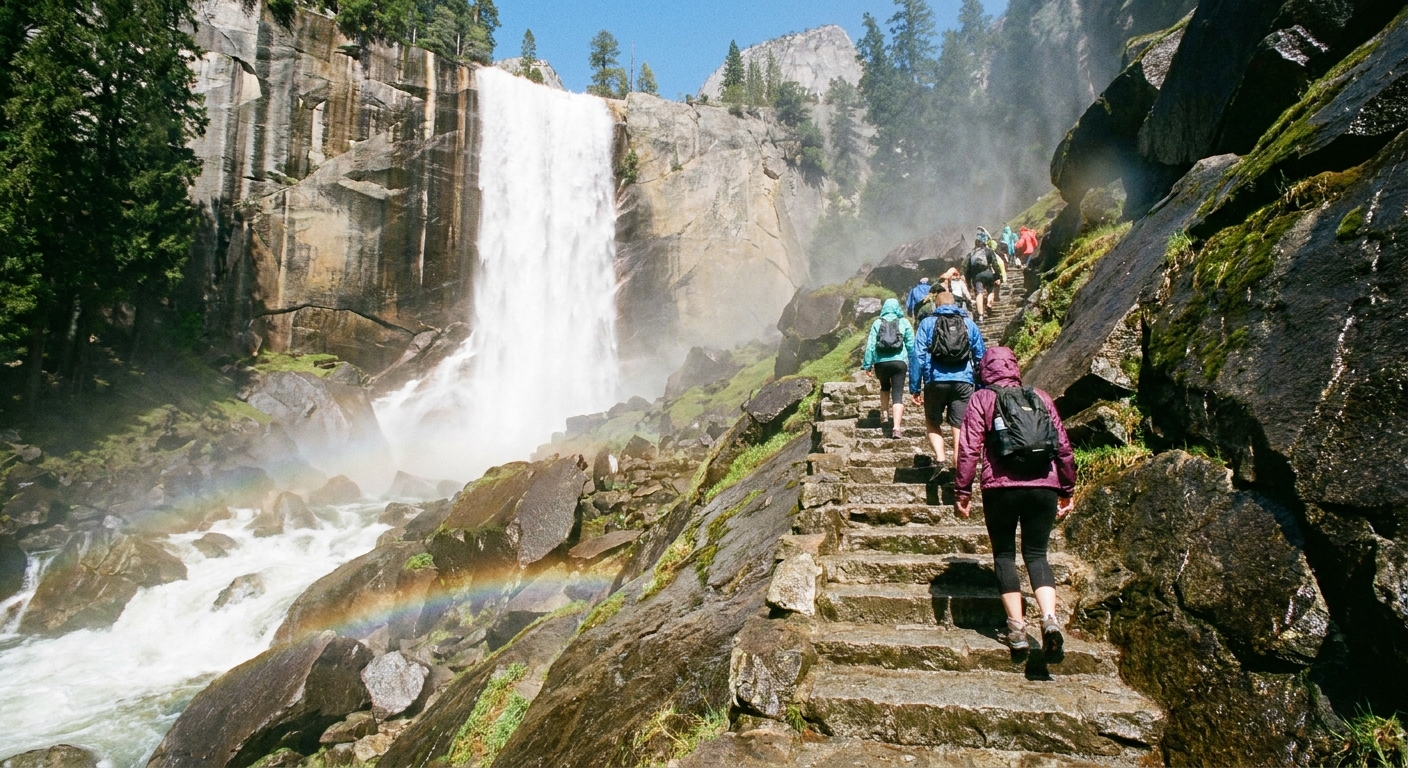
The Mist Trail is Yosemite Valley’s classic choose-your-own-adventure: a riverside stair climb that ends at the thunder of Vernal Fall, and if you keep going, the full-body roar of Nevada Fall. It is also the trail most likely to surprise you with a soaked jacket, a calf-cramping staircase, or a patch of ice right where you least want it.
This is a narrower, on-the-ground route guide for Vernal and Nevada Falls that focuses on what actually changes your day: Mist Trail vs John Muir Trail descent tradeoffs, wet-season footing, winter ice and closure realities, realistic turnaround points for families, and where to stage if shuttles or parking are tight.

Quick facts and what to expect
- Start point: Happy Isles Trailhead in Yosemite Valley
- Main goals: Vernal Fall Footbridge, top of Vernal Fall, Nevada Fall (top) via the Mist Trail corridor
- Trail type: Out-and-back or loop with John Muir Trail descent
- Terrain: Paved path to footbridge, then steep stone steps and slick granite, then forest and granite benches toward Nevada Fall
- Big reality check: The steep, slick section is typically the Mist Trail steps between the footbridge and the top of Vernal Fall, especially when wet or icy
Distances, elevation, typical time
Numbers below are approximate and can vary by exact route choice, conditions, and where you start in the Valley. Use them as planning anchors, not guarantees.
- Vernal Fall Footbridge: ~1.6 mi round trip | ~400 ft gain | ~1 to 1.5 hrs
- Top of Vernal Fall: ~2.4 mi round trip | ~1,000 ft gain | ~2 to 3 hrs
- Nevada Fall (top): ~5.4 mi round trip | ~2,000 ft gain | ~4 to 6+ hrs
- Common loop (up Mist Trail, down John Muir Trail): ~6.5 to 7.0 mi | ~2,000+ ft gain | ~5 to 7+ hrs
Most hikers do best choosing one of three honest endpoints (footbridge, top of Vernal, or Nevada Fall) and setting a time cutoff. If your group has mixed energy levels, decide your endpoint before you start and keep a flexible turnaround plan.
Getting there when parking or shuttles get messy
Best-case plan
When Yosemite Valley shuttles are operating, use them to reach the Happy Isles area, then walk to the trailhead. Shuttle routes and schedules change seasonally, and service can be reduced or paused depending on the year, so confirm the current plan before you build your day around it.
In peak season, the biggest win is simply starting early. The Mist Trail feels like a different hike before the mid-morning rush.
If shuttles are delayed or packed
- Stage near Valley trailheads early and be ready to walk extra Valley mileage rather than waiting in a long shuttle line.
- Build a buffer: If your plan depends on a shuttle transfer, give yourself extra time so you are not forced to rush down wet steps late in the day.
If parking is tight
- Arrive early enough to park once and commit. Moving your car midday often means losing your spot and burning time circling.
- Consider a late-afternoon strategy in shoulder seasons: crowds can thin later, but only do this if you are confident about your descent and daylight.
Whatever your logistics, the safest play is to avoid a scenario where you feel pressured to descend the Mist Trail steps quickly. That is how ankles get rolled and slips happen.
The route, step by step
Happy Isles to Vernal Fall Footbridge
This first stretch is the warm-up and the crowd filter. It is relatively straightforward, and it is also the most family-friendly section of the whole outing.
- Good for: families with small kids, travelers short on time, anyone testing a sore knee
- What you get: river views and a clear look at Vernal Fall ahead
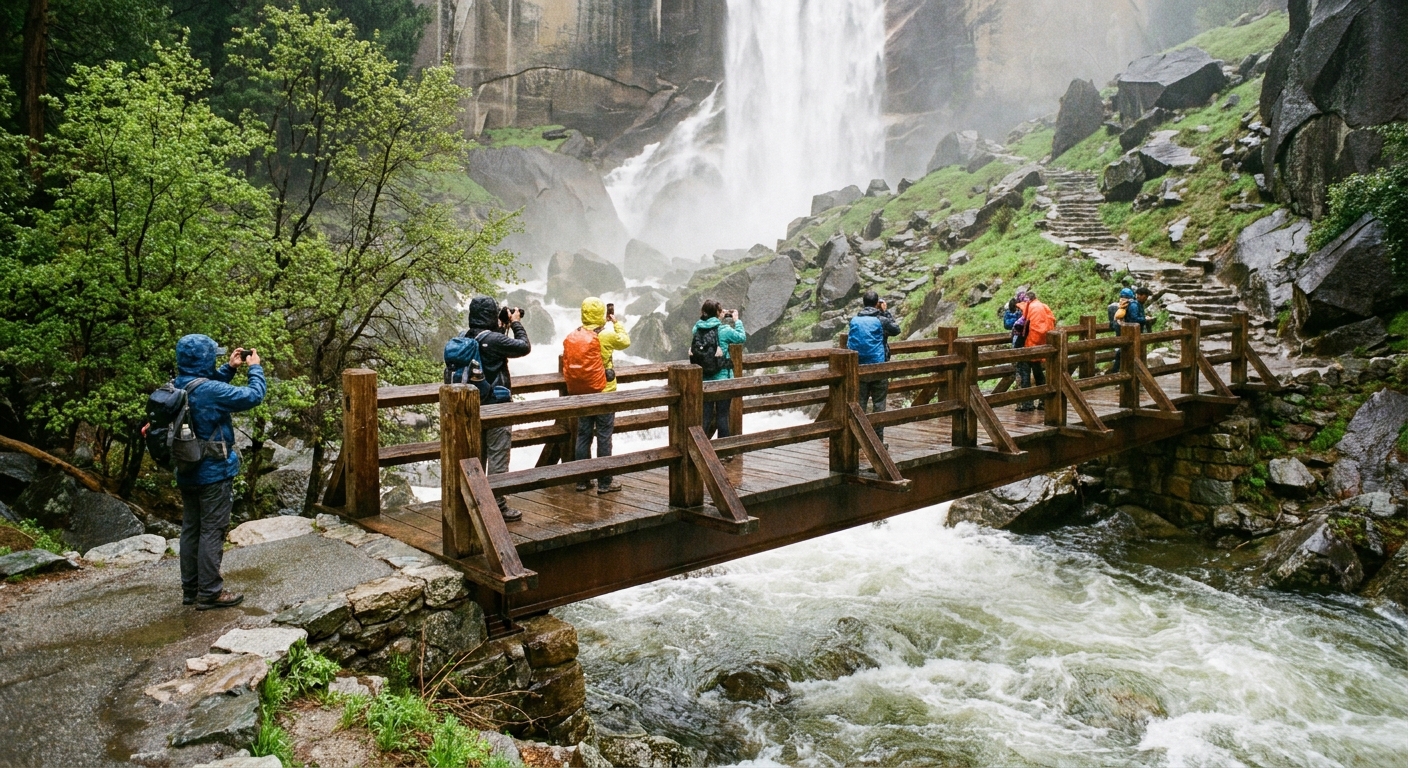
- Decision point: At the footbridge, decide whether you are truly committing to steep, often wet stone steps
Accessibility note: Portions of the approach are paved, but the full route to Vernal and Nevada includes steep stairs and uneven granite and is not wheelchair accessible.
Footbridge to the top of Vernal Fall (Mist Trail steps)
This is the section that earns the Mist Trail its reputation. You will climb steep granite steps beside the water. In spring and early summer, spray can soak the staircase, and the combination of water, smooth granite, and crowds is where most “I did not expect that” moments happen.
Footing tips that actually help
- Assume every dark patch is slick. Step on the rougher, textured stone where you can.
- Use the handrails when present. This is not the place to carry a coffee in one hand and a phone in the other.
- Give yourself space. If the steps are congested, wait for a gap so you are not forced into awkward side-steps.
- Pack for mist: a light rain shell or poncho and a dry bag for electronics. In heavy spray, you can get drenched fast.
When to skip the steps
If there is visible ice, if you are hiking with anyone who is unsteady on steep stairs, or if your group is already stressed at the footbridge, consider turning around there. The view is still great, and you avoid the highest-risk zone.
Top of Vernal Fall to Nevada Fall
Once you crest Vernal, the vibe changes. You trade the staircase intensity for a steadier climb through forest and granite slabs, with calm river scenery that can feel worlds away from the crowds below.
- Watch for: smooth granite that can stay damp in shady spots
- Hydration reminder: this upper portion can feel hotter and more exposed in summer than people expect
- Pacing: treat this as a steady grind, not a sprint after the steps
Mist Trail vs John Muir Trail descent
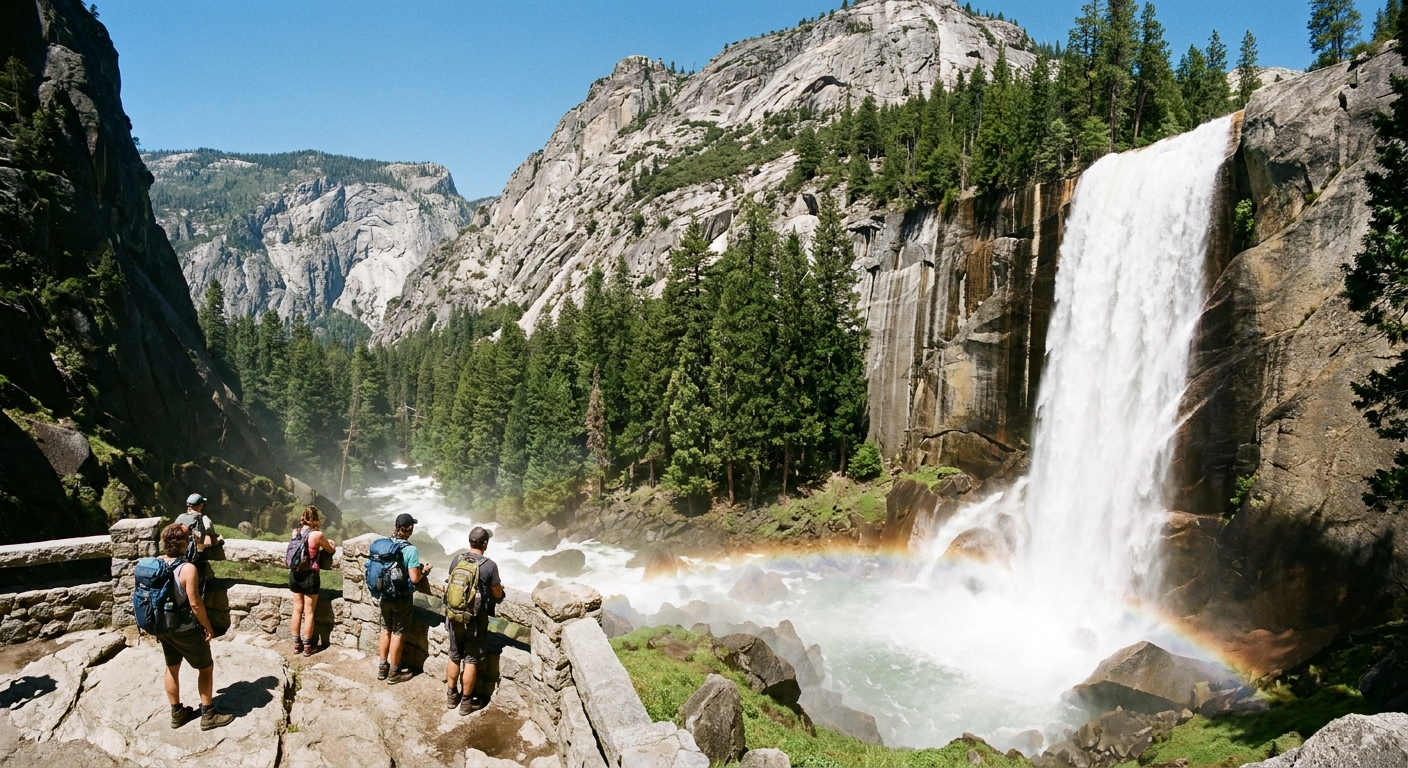
This is the decision that shapes your knees, your dryness level, and your crowd experience.
Descending the Mist Trail
- Pros: shortest way down, dramatic close-up views, straightforward navigation
- Cons: slippery when wet, crowded and stop-and-go, harder on knees because the steps are steep, higher risk if tired
- Best for: dry conditions, strong legs, early starts, confident footing on steep stairs
Descending via the John Muir Trail
- Pros: generally drier and less chaotic, more gradual grade, better option when the Mist Trail steps are wet or icy
- Cons: longer and can feel exposed in sun, adds distance and time, still steep in parts
- Best for: families and mixed-ability groups, anyone protecting knees, spring spray days, and winter when the Mist Trail is questionable
My practical rule: If your shoes are already soaked by the time you reach the top of Vernal Fall, descend via the John Muir Trail. You will likely be glad you did.
Seasonal flow and mist
Mist intensity is not constant. It changes with snowmelt, temperature, and even time of day.
- Spring to early summer: typically the highest flows and the most soaking spray on the steps. This is prime time for rainbows and drenched sleeves.
- Mid to late summer: flows often drop. You may get less mist, warmer temperatures, and a drier staircase, but do not count on it.
- Fall to winter: lower flow is common, but cold shade plus lingering moisture is what turns “wet” into “ice.”
Wet-season reality: avoiding slips
The Mist Trail can be wet from spring runoff into early summer, and that moisture is not just a comfort issue. It can set you up for slips now or for ice later when temperatures drop.
Where it stays wet longest
- The Mist Trail steps: constant spray zone near Vernal Fall
- Shaded corners and granite benches: damp patches linger in the shade even when the sun is out
What to wear and carry
- Traction matters: trail runners or hiking shoes with solid tread help more than you think on slick granite
- Layers: a light shell you can put on and off quickly
- Dry storage: keep phone, camera, and car keys in a zip bag
- Trekking poles: useful above Vernal, but awkward on the staircase when crowds are tight. If you use poles, shorten them and keep tips planted carefully.
If you would not walk down your home staircase at the same speed in the rain, do not do it here. Wet granite steps, fatigue, and crowds are a bad combo.
Winter ice and closures
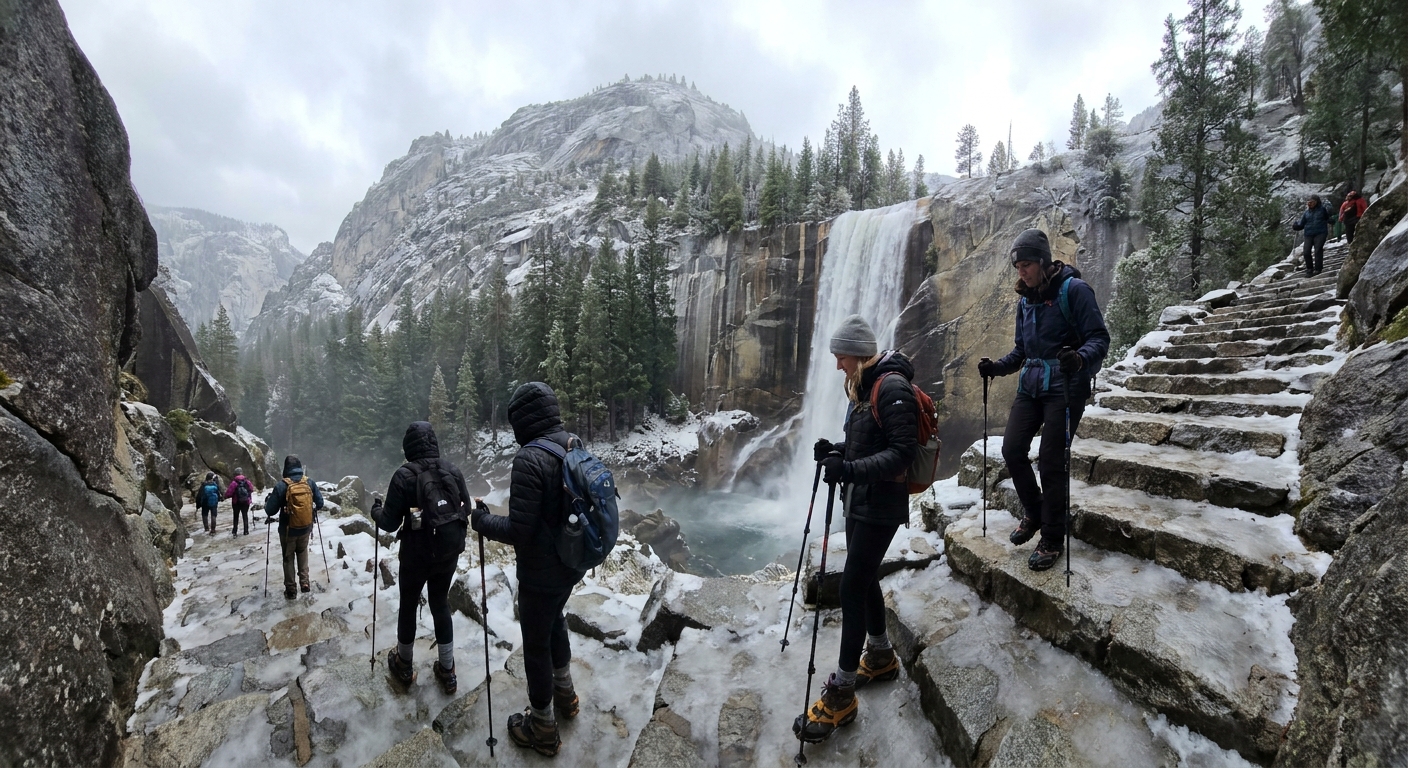
In winter, the Mist Trail’s biggest hazard is not snow. It is ice in the exact places your feet naturally land on the steps. Also, the park sometimes implements seasonal closures or restrictions on the Mist Trail near Vernal Fall due to hazardous ice. Do not assume you can always take the Mist Trail in winter, even with traction.
Common ice trouble spots
- Mist Trail steps above the footbridge: water spray plus shade can create persistent ice
- Shaded switchbacks and corners: refreeze happens early and often
- Near the top of Vernal: wind and spray can create thin, hard-to-see glaze ice
Safer winter approach
- Make the footbridge your default winter turnaround unless you have proper traction devices and experience on icy steps.
- If you continue, carry traction. Microspikes or similar devices can be the difference between a fun day and a rescue call, but they do not override closures or unsafe conditions.
- Use conservative timing. If the route is shaded, it can stay icy all day.
Conditions vary wildly by week and even by hour. Check current NPS trail conditions, alerts, and any closures before committing, and be willing to call it at the footbridge even if you feel strong. Ice does not care about your fitness.
Turnaround points for real families
On paper, “just go to Nevada Fall” sounds like a single plan. In real life, you want clear off-ramps.
1) Vernal Fall Footbridge
- Why it works: big payoff for moderate effort, easier footing, simpler logistics
- Great for: young kids, grandparents, winter days, anyone nervous about steep stairs
2) Top of Vernal Fall
- Why it works: you get the classic Mist Trail experience and a dramatic vantage point
- Watch for: fatigue on the descent. Going down wet steps is harder than going up.
3) Nevada Fall
- Why it works: the most complete waterfall experience in this corridor
- Family strategy: set a turnaround time, not just a destination. If you hit the time cutoff, turn around regardless of how close you feel.
Water, food, and basic logistics
- Do not drink river water untreated. If you plan to refill, bring a filter or treatment method.
- Carry more water than you think you need in summer. The upper section can feel hotter and more exposed than the Valley floor suggests.
- Snacks help the staircase. A small, steady calorie trickle beats one big break when you are already wiped.
- Restrooms: use facilities when you see them, especially with kids. Availability can be seasonal.
Crowd tactics
- Start early: the single best crowd reducer
- Take breaks away from choke points: step aside fully so others can pass
- Choose your descent wisely: John Muir Trail often feels calmer and reduces the stop-and-go effect
- Be patient on the steps: rushing in wet conditions is the classic mistake
If you want the iconic mist-and-rainbow moment without the shoulder-to-shoulder feeling, aim for early morning in peak season or a weekday in shoulder months.
Safety and Leave No Trace
- Stay on the trail: granite edges and wet rocks near the river are not shortcuts
- Keep distance from the water: fast-moving current is powerful even when it looks calm
- Pack out everything: including food scraps and tissues
- Check current regulations: shuttle ops, trail closures, and seasonal advisories change year to year
Yosemite is both a world-class landscape and a living community of wildlife and visitors. A slower, more intentional pace keeps you safer and keeps the trail experience better for everyone.
A simple game plan
If you want Vernal without stress
- Go early
- Hike to the Vernal Fall Footbridge
- Turn around if the steps look wet, icy, closed, or overcrowded
If you want Vernal plus Nevada
- Start early and bring a shell for spray
- Climb Mist Trail up if conditions and any closures allow
- Descend via the John Muir Trail if wet, icy, or if your group is tired
Beyond this guide
If you continue past Nevada Fall toward Little Yosemite Valley or Half Dome, permits and additional planning can apply depending on your exact destination. Treat that as a separate trip plan, not a casual add-on.
The Mist Trail is famous for a reason. It is also the kind of trail that rewards humility. Plan for spray, respect ice, confirm current conditions, and pick the descent that matches your group. You will earn the best kind of Yosemite souvenir: that clean, satisfied feeling of doing it the right way.