What to Do If a Mountain Goat Approaches You

Maya Lin
Maya Lin is a travel journalist and outdoor enthusiast who believes the best trips combine rugged adventures with urban comforts. After spending six years backpacking across four continents, she founded Trail & Town Guide to help fellow travelers navigate both hidden mountain passes and bustling city neighborhoods with confidence.
The first time a mountain goat walked directly at me, I did what most of us do on an alpine trail. I stopped. I stared. I took one step sideways for a better photo. The goat took one step forward, calm as a metronome, like it had a meeting to get to. That was my cue that this was not a random “wildlife sighting.” It was an interaction, and I was part of it.
In places like Washington’s Enchantments, Glacier National Park, and Rocky Mountain National Park, mountain goats have learned an unhelpful lesson: humans equal salt. Sweat on packs, salty snacks, urine around camps, even the minerals in dirt where people linger can draw them in. The goal in any goat encounter is simple: create space, remove the reward, and leave the goat an exit route.
Why goats approach people
Mountain goats are not predators, and most approaches are not aggression. They are often salt-seeking. In heavily visited alpine areas, goats may:
- Follow hikers to lick salty sweat from clothing or packs.
- Stand in the trail waiting for people to move, because it works.
- Hover near rest spots where snack crumbs and sweat collect.
- Investigate camps for pee-soaked soil, spills, or food smells.
This is exactly why “It came right up to us and seemed friendly” is not a cute story. It is a red flag that the goat has been rewarded before.
Quick response
If a goat is walking toward you, treat it like a slow-moving situation you can solve with calm, boring consistency.
1) Stop feeding the situation
- Do not offer food, salt, or a closer look. Even “just letting it sniff my pack” trains the behavior.
- Put snacks away. Close pockets. Zip hip belts. Don’t set food down “for a second.”
2) Create distance
Wildlife distance rules vary by park and species, so follow posted guidance first. If you do not see specific guidance, a solid baseline on open trail is about 50 yards, and more if the goat keeps advancing. In tight alpine terrain, do your best to maximize space without stepping into danger.
- Back away slowly. Do not run.
- Angle off the trail only if it is stable ground. Avoid loose scree edges and steep drop-offs.
- Keep the goat in view and watch its body language.
3) Yield the trail
If the goat is on the trail and you cannot safely pass with plenty of room, you yield. Step off to a secure spot and let it go by. Passing close is how people end up surprised by horns.
4) Be boring
Mountain goats are persistent when they expect salt. Your job is to be the least rewarding thing in the basin.
- Stay quiet and calm. No yelling contests, no “shooing” that turns into crowding.
- Do not crouch to the goat’s level for photos.
- Group up. A tight group is easier to manage than scattered hikers.
5) If it keeps coming, get firmer
If a goat continues closing the distance, escalate without approaching it.
- Wave arms and look bigger while you continue backing away.
- Throw small rocks only as a last resort and only where allowed by local guidance, aimed to land near the goat, not at its head. The point is to create an unpleasant boundary, not to injure.
- Use trekking poles as visual extension, not as weapons.
6) Leave if it lingers
If a goat is lingering near a pass, a lake outlet, or a camp zone and will not disengage, the safest move is often to move on. This is especially true with habituated goats in popular basins.
7) Report problem behavior
If a goat is repeatedly approaching people, blocking trail traffic, or hanging around camps looking for salt, report it to rangers when you can. That information helps land managers target education and, when necessary, management actions before someone gets hurt.
How far to yield
Distance guidance is messy in the alpine because trails pinch into boulder fields, snow traverses, and narrow ledges. Here is how I think about it on the ground:
- Ideal: 50 yards or more, with a clear line of sight, unless posted rules require more.
- Minimum on constrained trail: enough space that if the goat lunged or pivoted, you would still not be within horn range. If that sounds hard to judge, it is. That is why backing off and waiting is often the smartest play.
- Never: passing shoulder-to-shoulder, stopping in a choke point, or letting it walk between you and your group.
Remember: goats do not need much warning to use their horns, and the risk rises when people crowd them for photos or block their route.
Body language
Most goats look serenely unimpressed. But there are signals that mean you should increase distance immediately:
- Head down with horns forward
- Pawing the ground
- Short bluff charges or quick steps toward you
- Direct stare while it keeps advancing
- Raised hair along the back or a tense, rigid posture
If you see any of these, stop trying to “solve” it in place. Back away to a safer, wider spot and reassess.
Goat or sheep?
In parts of the Rockies especially, people mix up mountain goats and bighorn sheep. You do not need a perfect ID to do the right thing, but it helps. Goats are usually bright white with narrow black horns and a blocky, shaggy look. Bighorns tend to be brown, with thicker curved horns (especially on rams). Either way, the safe play is the same: give them space and do not push for a photo.
Seasonal caution
There are times of year when I give goats extra room. In spring and early summer, nannies may be more defensive around kids. In late fall during the rut, billies can be more intense, more focused, and less inclined to yield. None of that changes the basics, it just raises the bar for how early I back off.
The salt problem
I know. Nobody wants a lecture about urine on a mountain. But with goats, it matters because salt is the currency.
On day hikes
- Pack salty snacks away fast. Don’t leave wrappers open in side pockets.
- Do not toss apple cores or crumbs. It changes animal behavior and draws wildlife into people zones.
- Avoid lingering at the same “popular rock” where dozens of hikers have sweated, snacked, and peed nearby.
At camps and in high-use basins
- Follow local human waste rules first. In goat country, the consistent goal is to avoid creating a salty “lick” spot near tents, cooking areas, and water.
- Disperse urine away from camp rather than using the same little patch of soil everyone uses. When appropriate and allowed, durable surfaces like bare rock can help prevent a concentrated lick spot from forming.
- Keep cooking areas clean and pack out food scraps. For greywater, follow local regulations on straining, dispersal distance, and where it is allowed. The goal is not to leave a smell and mineral buffet.
Different parks and wilderness areas can have specific guidance for human waste and greywater. Follow local rules first. But the general principle for goat country is consistent: don’t concentrate salt where people sleep and eat.
Dogs and goats
If you hike with a dog, treat goats as a major management moment. Goats may see dogs as predators and respond aggressively, or they may be drawn in by salty gear and the commotion.
- Leash your dog early, before you are close. A “just in case” leash at 10 feet is too late.
- Do not let your dog chase or bark and lunge. That can provoke a defensive charge.
- Increase distance and leave the area if the goat is standing its ground.
- Never put yourself between a goat and your dog at close range. Create space for both of you instead.
If a trail system or zone prohibits dogs, take that seriously. In popular alpine areas, dog-goat conflicts are one more way goats get habituated and stressed.
What not to do
- Do not take selfies with a goat. If you are close enough for a good selfie, you are too close.
- Do not surround it with a semicircle of hikers.
- Do not try to “herd” it off the trail by walking toward it.
- Do not throw food to distract it or “get it to leave.”
- Do not assume horns are only dangerous on males. Any goat can use horns effectively.
Regional notes
Goat behavior varies by place, season, and how many humans they have learned from, but a few patterns show up consistently in these regions.
Enchantments (Washington)
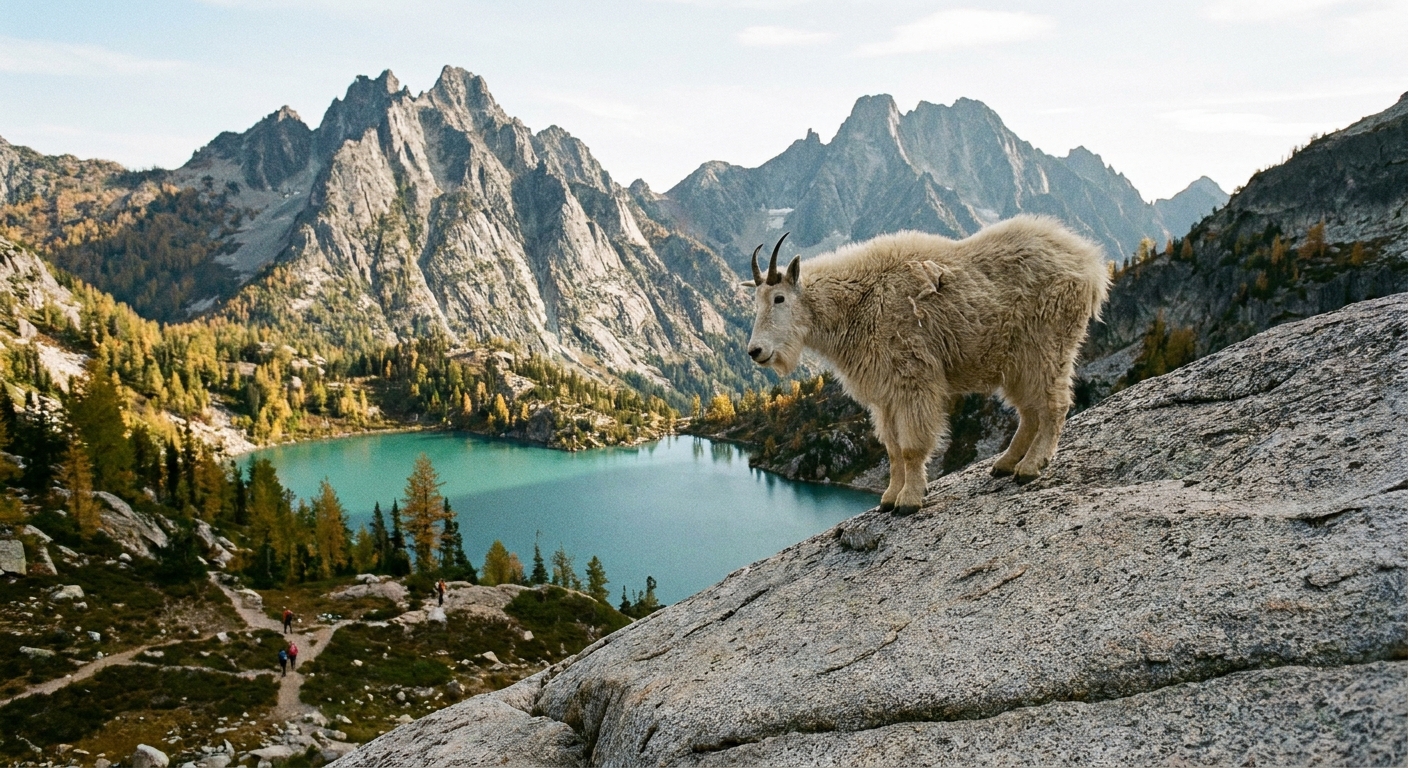
The Enchantments are famous for their granite, larches, and yes, goats that have seen a lot of people. In heavily used zones, goats may be bold and persistent.
- Expect goats near popular lakes and passes, especially where people stop for long breaks.
- Be extra strict about snacks and pee habits around core basin camps and day-use hotspots.
- Do not hold your ground in a narrow spot. Step to stable rock and let the goat pass.
Olympic Peninsula (Washington)
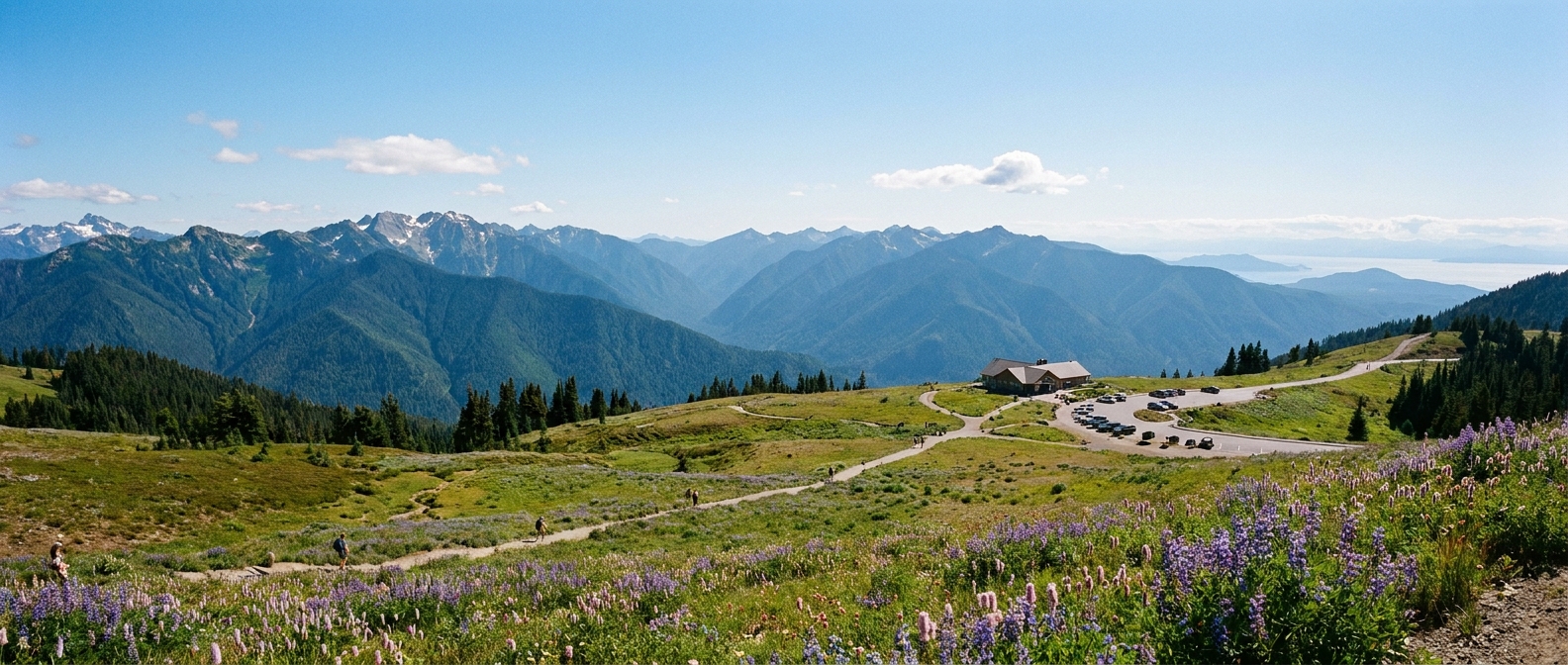
A quick correction that matters for trip planning: the Olympic National Park goats that used to be a familiar hazard on certain high-country trails were part of a non-native population, and the National Park Service carried out a major capture, relocation, and lethal removal effort centered in 2018 to 2020. That means goats are no longer common the way they once were inside the park, though occasional individuals have still been documented and management has continued as needed.
Many captured goats were relocated to the Cascades, including the North Cascades region. What I take from the Olympics story is the broader lesson: when goats get habituated to human salt, it stops being a cute wildlife moment and turns into a long-term management problem. If you are hiking elsewhere on the Olympic Peninsula or in nearby ranges where goats are present, the same basics apply:
- Do not reward approach behavior with snacks, proximity, or attention.
- Keep your waste and salty gear dispersed so you are not creating a lick spot at camps or viewpoints.
- Back off early on narrow trail, because standoffs teach goats that people move.
Glacier National Park (Montana)
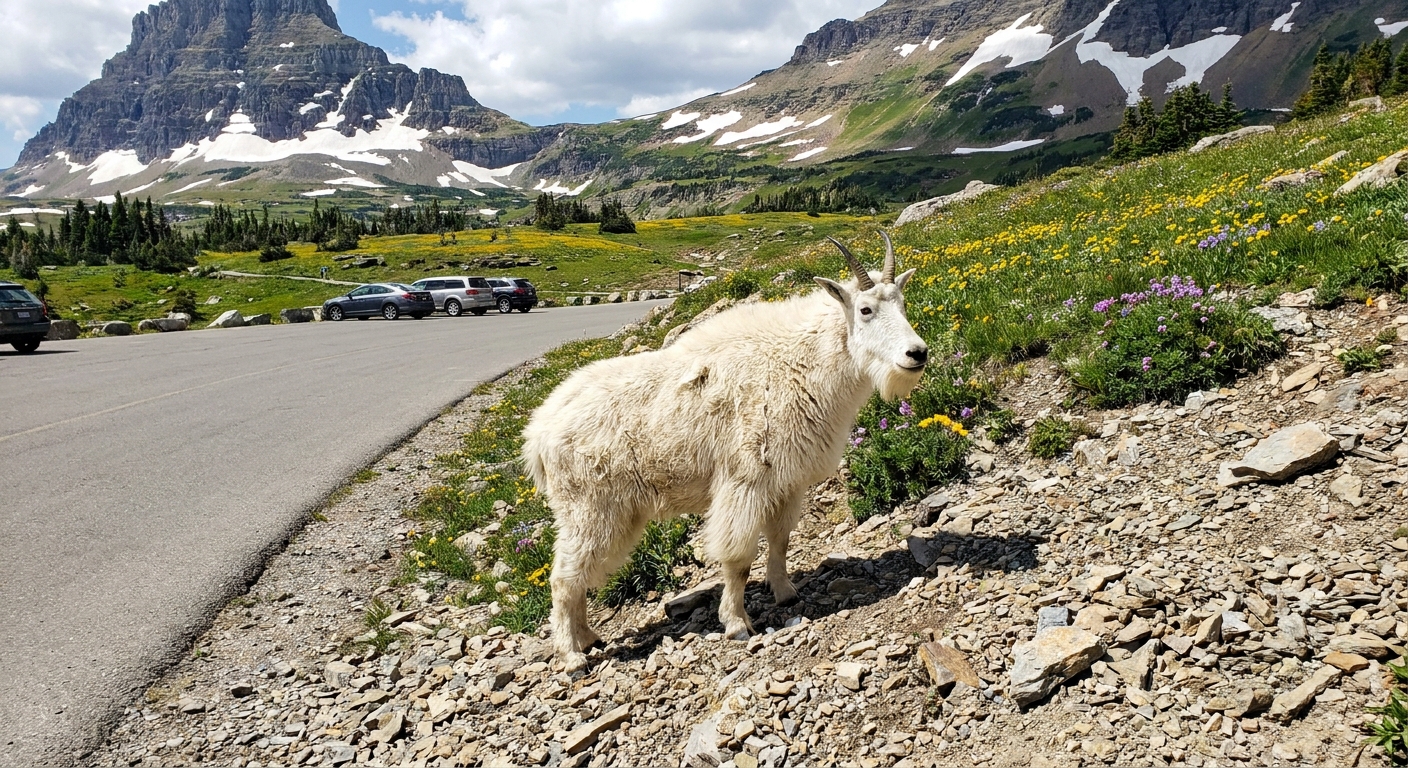
Glacier’s iconic spots like Logan Pass can put goats and people in the same frame, sometimes very close. Roads and pullouts add another layer of chaos.
- Don’t let crowds push you closer. If people cluster, step back farther than you think you need.
- Give goats the right of way on narrow trail segments. Wait it out.
- Keep kids close and calmly behind you when yielding. Treat it like a road crossing, not a petting-zoo moment.
Rocky Mountain National Park (Colorado)
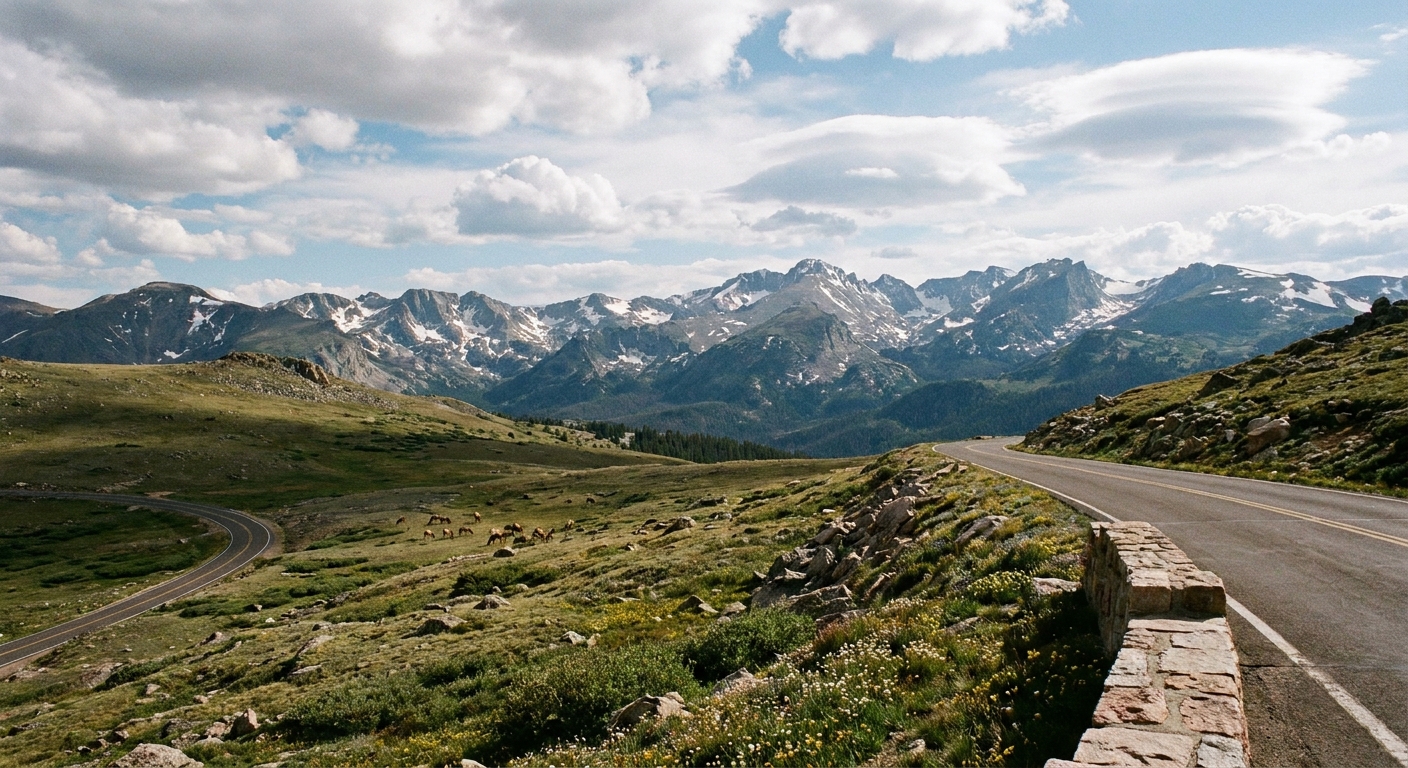
Back home in Colorado, I have seen plenty of folks assume goats are basically fluffy boulders with legs. In RMNP, terrain can be steep and exposure is real.
- Do not step onto sketchy ledges to avoid a goat. Your footing comes first.
- If you are on a narrow trail with exposure, turn around and retreat to a wider turnout rather than squeezing past.
- Be cautious near mineral-rich areas where animals may linger.
If a goat charges
True charges are less common than approaches, but they can happen, especially if people crowd an animal, it feels cornered, or it has learned to “bully” hikers for space and salt.
- Get behind a solid barrier if possible, like a large boulder or thick tree.
- Protect your core with your pack in front of you if you cannot retreat quickly.
- Do not fall if you can help it. Back away with careful steps.
- Leave the area as soon as you safely can.
If someone is injured, treat it as a medical emergency and contact park rangers as soon as you have a safe signal or reach other hikers. Even without an injury, reporting a goat that is repeatedly approaching people or acting aggressively helps land managers respond appropriately.
Photo etiquette
I love a wild goat photo as much as anyone, especially in that bright-white-against-granite way that looks like a postcard. The best shots are taken with patience, not proximity.
- Use zoom and stay put.
- Let the goat move through the landscape rather than positioning yourself in its path.
- If it is looking at you more than grazing, you are too close.
Checklist
- Stop and assess: is it approaching or just passing through?
- Secure food and keep packs zipped.
- Back away and create distance, aim for about 50 yards if possible unless local rules say otherwise.
- Yield the trail in narrow areas. Wait, do not squeeze past.
- Leash dogs and keep your group together.
- Escalate calmly if it continues approaching: make yourself bigger, throw small rocks near it only if needed and allowed.
- Leave the area if it will not disengage.
- Report repeat behavior to rangers when you can.
FAQ
Are mountain goats usually aggressive?
Most are not “aggressive” in the way people mean it. Many are habituated and bold. That can still be dangerous, because bold animals are more likely to approach closely, block trails, and use horns if people crowd them.
Should I stand my ground?
No. With goats, standing your ground often turns into a standoff that ends with the goat too close. Back away and yield early.
Is it okay to scare a goat away?
Your first move should be distance and removing rewards. If a goat continues advancing, you can escalate by making yourself bigger and, if necessary and allowed locally, throwing small rocks near it to reinforce a boundary. Do not chase it or approach it.
What if the goat is on the only narrow part of the trail?
Retreat to a wider spot and wait. In exposed alpine terrain, the safest choice is usually patience, not squeezing past.
Do mountain goats go after urine?
They can. Salt and minerals are the draw. That is why concentrated pee spots around camps and popular rest areas can attract goats and keep them hanging around people.